

.svg)


Privacy-Preserving Occupancy Sensors Explained
For facilities teams trying to understand how space is used, traditional occupancy monitoring solutions like cameras and Wi-Fi tracking present a common problem. The data you need to make good decisions about your portfolio comes bundled with personal information that you may not be legally allowed to collect.
That problem is only growing, as GDPR enforcement is escalating, European works councils are blocking camera-based deployments, and US state privacy laws are expanding the definition of personal data. Even organizations that operate in less regulated environments are facing internal pushback from employees who don't want to feel surveilled at work.
Privacy-preserving occupancy sensors offer a different approach. They capture space utilization data (how many people, where, and when) without ever identifying who. Butlr has deployed more than 30,000 sensors worldwide using this approach, capturing accurate occupancy data without collecting a single piece of personal information.
Here's what these sensors do differently, how they compare to alternatives, and where they can go that other technologies cannot.
What "Privacy-Preserving" Actually Means in Occupancy Sensing
Privacy-preserving, applied to occupancy sensors, means anonymity is built into the hardware and the data pipeline from the start. It is not applied as a software filter after the fact.
Some systems collect identifiable data first and then strip it. Cameras with face-blurring algorithms, for instance, still capture a full image before the software processes it. Wi-Fi tracking with MAC address hashing still detects a device identifier before obfuscating it. In both cases, the raw data exists, even if briefly, and that creates risk. It can be breached, subpoenaed, or exposed by a policy change or a misconfigured setting.
Truly privacy-preserving sensors never generate identifiable data at any point in the process. There is no image, no device ID, no personally identifiable information to anonymize, because none was captured in the first place.
Thermal occupancy sensors are the clearest example. They detect body heat signatures to determine presence, count, and movement.
The output is numerical, such as "3 people present" or "12 passes in the last hour." No images. No facial recognition. No device fingerprinting. The sensor cannot physically produce an image of a person, which is a fundamentally different privacy posture than a camera that chooses not to store one.
For enterprise buyers, this simplifies the compliance path considerably. Sensors that never capture PII don't trigger the same regulatory scrutiny under GDPR. Works council reviews move faster when the hardware in question has no capability to identify individuals. And SOC 2 Type II certification, which is a baseline expectation for enterprise deployment, is easier to maintain when the data architecture has no PII to protect in the first place.
Where Privacy-Preserving Sensors Can Go That Others Can’t
Where you can physically deploy sensors depends on privacy. And that determines how complete your utilization picture actually is.
Camera-based and device-tracking solutions are either legally prohibited or practically unworkable in a number of space types that generate important utilization data. These are the most common gaps:
- Restrooms and wellness rooms. These spaces produce some of the most valuable operational data for facilities teams, including cleaning frequency needs, supply restocking triggers, and capacity management signals. Cameras are a non-starter for obvious reasons. Thermal sensors work here without any privacy concern, giving facilities teams the data they need to shift from fixed cleaning schedules to usage-based ones. If a restroom on the third floor averages 80 visits per day while one on the sixth floor sees 15, you can allocate cleaning staff accordingly rather than sending a crew to every restroom on the same two-hour rotation.
- Healthcare and senior living facilities. Patient rooms, therapy areas, and common spaces are governed by privacy regulations (HIPAA, state-level patient rights) that heavily restrict visual monitoring. Thermal sensing enables safety monitoring, fall detection, and space utilization analysis without capturing patient identity.
- Laboratories and classified environments. Research facilities and government-adjacent spaces often have blanket restrictions on any imaging technology. Thermal sensors capture utilization without creating a visual record of who is present or what they're working on.
- Retail and public-facing spaces. Foot traffic counting and zone utilization analysis without capturing customer faces or device data. This is especially relevant in jurisdictions with biometric data laws, such as Illinois BIPA, where even passive collection of facial geometry creates liability.
- Prayer rooms, lactation rooms, and other sensitive spaces. Utilization data helps facilities teams right-size these spaces and ensure they meet actual demand, but occupants expect complete privacy. Thermal sensors are often the only technology that can provide both.
If your occupancy sensing solution cannot cover these spaces, you are working with an incomplete dataset. Portfolio-level decisions about space allocation, cleaning, and energy use are only as good as the coverage they are based on. A system that covers 85% of your floor area but misses the 15% that includes restrooms, wellness rooms, and labs is missing real operational value.
Occupancy Sensor Technologies Compared by Privacy Risk
The comparison below maps each major occupancy sensing technology against the factors that matter most for enterprise deployment: how it collects data, what that data contains, and the privacy exposure it creates.
The tradeoff most buyers face is between accuracy and privacy. Cameras are accurate but carry serious privacy risks. PIR sensors are private but too imprecise for real space utilization decisions. Thermal sensing, on the other hand, delivers headcount-level accuracy with zero identity data.
These technologies are not always mutually exclusive. Many organizations use a layered approach: PIR for simple triggers like lighting automation, and thermal sensors for the actual utilization measurement that informs portfolio and operational decisions. The right architecture depends on what you need each space type to tell you.
One factor that's easy to overlook in a feature comparison is the behavioral effect of visible surveillance hardware. Cameras change how people use a space. Employees who know they're on camera behave differently in common areas, avoid certain rooms, or raise concerns that slow adoption. Thermal sensors, on the other hand, are small, ceiling-mounted devices that occupants typically cannot distinguish from standard building hardware. The data is more representative of actual behavior when the measurement tool doesn't alter the behavior it's trying to measure.
One Question to Ask Every Vendor You Evaluate
Before comparing spec sheets or compliance certifications, ask each occupancy sensor vendor a simple question: "Show me what your sensor actually sees."
The answer will tell you more about your real privacy exposure than any whitepaper. A camera-based system will show you a video feed of people in a room, even if the vendor says faces are blurred downstream. A Wi-Fi tracking system will show you device IDs moving through a floorplan. A thermal sensor will show you anonymous heat signatures and a count, with no way to identify anyone, because there is nothing to identify.
For example, here is what a Butlr sensor “sees”:
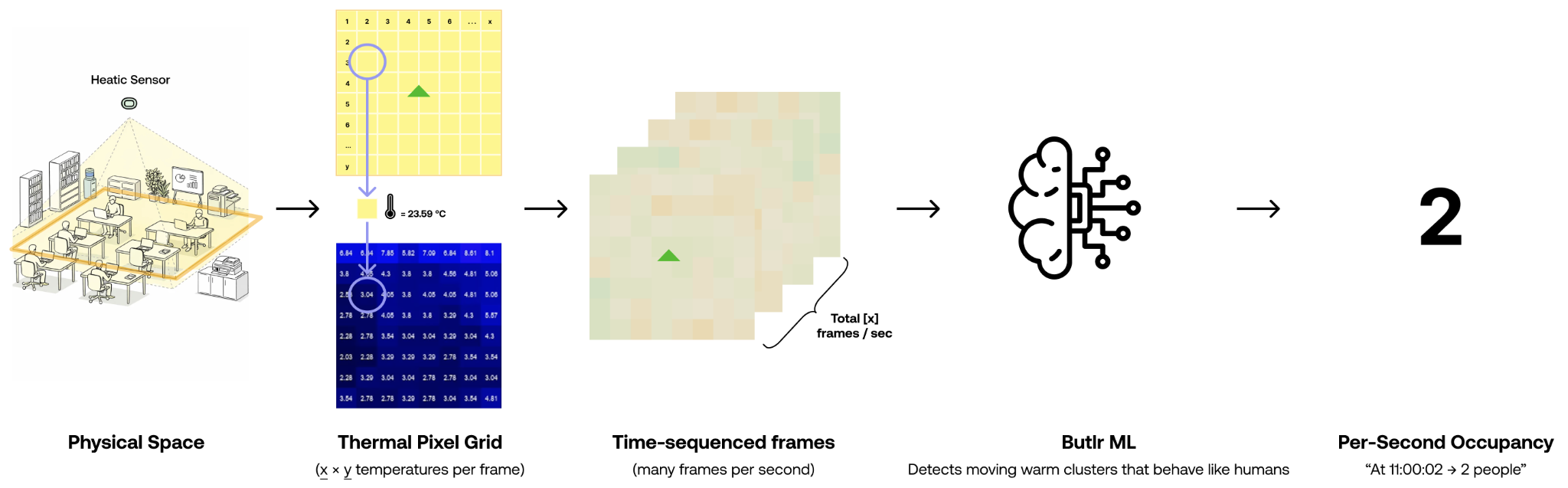
This is also the fastest way to pressure-test any vendor's privacy claims. If they say "privacy-first" but their sensor output contains images or device data, the architecture is not private by design.
Butlr's thermal sensors are deployed across offices, labs, retail spaces, and sensitive environments worldwide. No cameras, no PII, no blind spots in your data. To see how they'd work in your buildings, request a demo.
.png)

%20(1).png)
.png)
.webp)