


.svg)


5 Best Vergesense Alternatives: 2026 Comparison Guide
VergeSense has earned a reputation as a solid workplace analytics platform, especially for teams that want deep retrospective reporting and industry benchmarks. But it doesn't work for every organization.
Facilities and workplace teams often run into friction with camera-based sensing that triggers lengthy privacy reviews, deployment timelines that stretch into months before any usable data flows, and an analytics layer that's better at telling you what happened than helping you act on what's happening now. For organizations managing global portfolios with mixed privacy regulations, these issues can stall rollouts entirely.
If those challenges sound familiar, there are alternatives worth evaluating. This article breaks down the top VergeSense alternatives built to address these gaps. For each platform, we'll cover key features, how they compare to VergeSense, pros and cons, and what type of organization each one fits best.
Shortcomings of VergeSense
While VergeSense is a capable occupancy analytics platform, several limitations lead workplace and facilities teams to explore alternatives:
- Camera-based sensing creates privacy and compliance bottlenecks: Because VergeSense relies on vision-based occupancy sensors, deployments often require legal review, IT security approval, works council sign-off, and employee communication plans before a single sensor goes live. In regions with strict data protection laws (particularly across EMEA), this can delay projects by weeks or months.
- Deployment timelines slow time to value: Camera sensors require careful placement, calibration, and structured rollout phases. For teams that need occupancy data quickly to inform lease decisions, space consolidation, or hybrid work policies, the time from purchase to actionable insight can stretch well beyond what the business timeline allows.
- Difficult to scale across large, distributed portfolios: While VergeSense can operate globally, scaling camera-based systems across hundreds of buildings with varying privacy laws, building standards, and labor norms introduces significant logistical complexity. Each new region or building type can require its own approval process.
- Analytics-focused platform with limited real-time operational impact: VergeSense excels at retrospective reporting and benchmarking, but teams looking to trigger real-time actions (automated cleaning schedules, HVAC adjustments, or live space availability) may find the platform better suited to planning than day-to-day operations.
- Selective coverage model rather than full-portfolio visibility: Camera-based deployments tend to focus on high-value spaces where sensor placement can be optimized, which can leave teams with a sampled view of occupancy rather than a complete picture across entire floors and buildings.
- Platform-centric approach can limit integration flexibility: VergeSense channels much of its occupancy data through its own Meridian analytics layer. Teams that rely heavily on existing integrated workplace management systems (IWMS), building management systems (BMS), business intelligence (BI) tools, or digital twin platforms may find it harder to get raw data flowing directly into their preferred systems.
With these limitations in mind, here's how the top alternatives compare and where each one fits best.
Best VergeSense Alternatives at a Glance
Butlr
Butlr is a privacy-first artificial intelligence (AI) platform for intelligent buildings. Its thermal sensors detect presence, movement, traffic flow, and space usage through heat patterns alone, delivering 95% accuracy with real-time headcounts, coordinates, and dwell time. The hardware is physically incapable of capturing images, biometric data, or personally identifiable information (PII).
Here’s what sets Butlr apart from VergeSense. For a detailed Butlr vs. VergeSense comparison, see our head-to-head guide.
1. No cameras, no compliance friction
That thermal-only approach eliminates the privacy and compliance friction that slows down camera-based platforms like VergeSense. With Butlr, there are no images to regulate, no legal and IT approvals to navigate, and no employee concerns about surveillance.
This also makes coverage possible in privacy-sensitive environments like wellness rooms, shared lounges, and clinical spaces where camera-based sensing would face pushback or outright prohibition. And in regions with strict data protection laws, fewer stakeholders need to sign off before deployment can begin.
2. Unbox to usable data in days
Butlr's Heatic 2+ sensors are wireless, battery-powered, and simple to install. Teams can go from unboxing to usable data in days, not months.
The sensors also support wired, wireless, or cellular connectivity, which gives teams flexibility when rolling out across buildings with different network setups. That combination of lightweight hardware and flexible networking makes multi-site and multi-region deployments faster and less expensive than platforms that require professional installation at every location.
3. Built to fit into your existing tech stack
Butlr's API-first architecture pushes real-time occupancy data directly into IWMS, BMS, energy, cleaning, and BI tools via REST APIs and webhooks. Where VergeSense channels data through its own analytics platform for benchmarking and reporting, Butlr lets teams embed occupancy intelligence into the workflows and systems they already run.
4. Portfolio-wide coverage, not selective sampling
At scale, that adds up to coverage across entire floors, buildings, and portfolios rather than selected high-value rooms. And because Butlr surfaces real-time occupancy signals, teams use it to drive operational decisions like space planning, energy optimization, and cleaning schedules rather than relying on after-the-fact reporting.
Butlr vs VergeSense at a Glance
What Real Customers Are Saying About Butlr
"Butlr’s technology has proven to be indispensable to our workplace endeavors. From repurposing office spaces to implementing smart cleaning schedules, we are revolutionizing the way we operate, ensuring efficiency and productivity at every step.”
- Zubair Chowdhry, Workplace Technology & Data Lead at Snowflake
“Butlr’s thermal approach is more reliable, scalable, and accurate than the other technologies we have seen. The best part: our customers have a seamless experience – we simply pull data and alerts from Butlr’s API and expose it to care staff who are already familiar with our software."
- Sami Herrala, CTO & Founder at 9Solutions
Pricing
Custom pricing available upon request.
Right-size your portfolio, cut operating costs, and make confident space-planning decisions backed by real occupancy data. Get a demo of Butlr to see how teams use privacy-safe, real-time occupancy intelligence to act faster and plan smarter across their entire workplace footprint.
Density
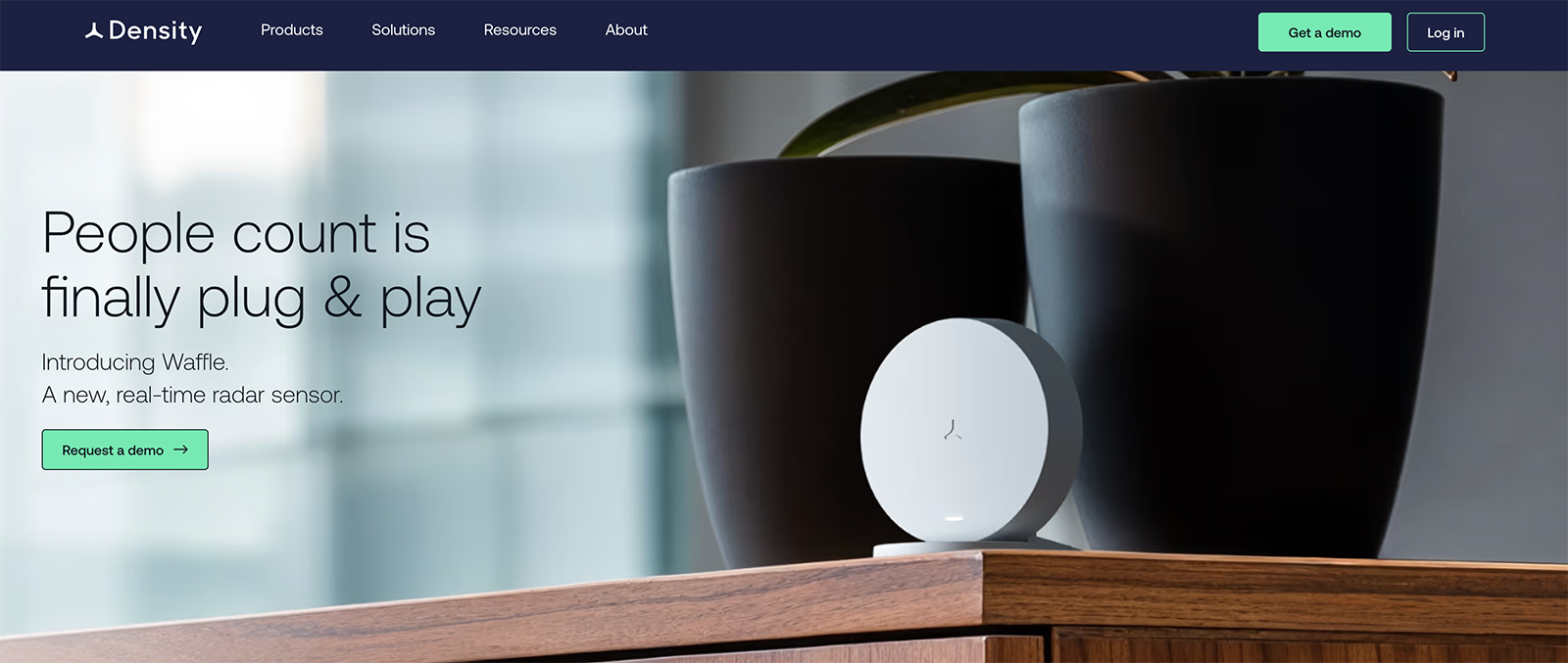
Density is a people analytics platform built on radar and depth sensing technology. It covers a range of space types from open floor plans and lobbies down to individual meeting rooms and desks. The platform pairs its sensor hardware with a polished, out-of-the-box analytics layer for utilization dashboards, heatmaps, occupancy trends, and capacity planning.
It's designed for corporate real estate teams, facilities managers, and workplace strategists who want a strong reporting experience without heavy configuration.
Density vs VergeSense at a Glance
Pros
- Offers a self-installable sensor option, which can simplify and accelerate rollouts compared to platforms that require professional installation for every sensor type.
- Includes built-in wayfinding capabilities, giving employees a way to find available spaces in real time without needing a separate tool.
- Also offers an advisory services arm for hands-on site planning and workplace strategy support alongside the technology.
Cons
- Only the newest sensor option is self-installable; the rest of the lineup can require more involved setup, which may slow down large-scale rollouts.
- Occupancy data is primarily accessed through the platform's own analytics layer, so organizations that want to push data into their own systems may face more friction than with API-first alternatives.
- Radar-based sensing generates spatially resolved data that some InfoSec teams and regulators in EMEA and APAC may classify as sensitive tracking, which can create approval delays.
Pricing
Sensors start at $149 per unit. Software starts at $8/unit per month for rooms and phone booths and $2.50/unit per month for desks (billed annually).
XY Sense
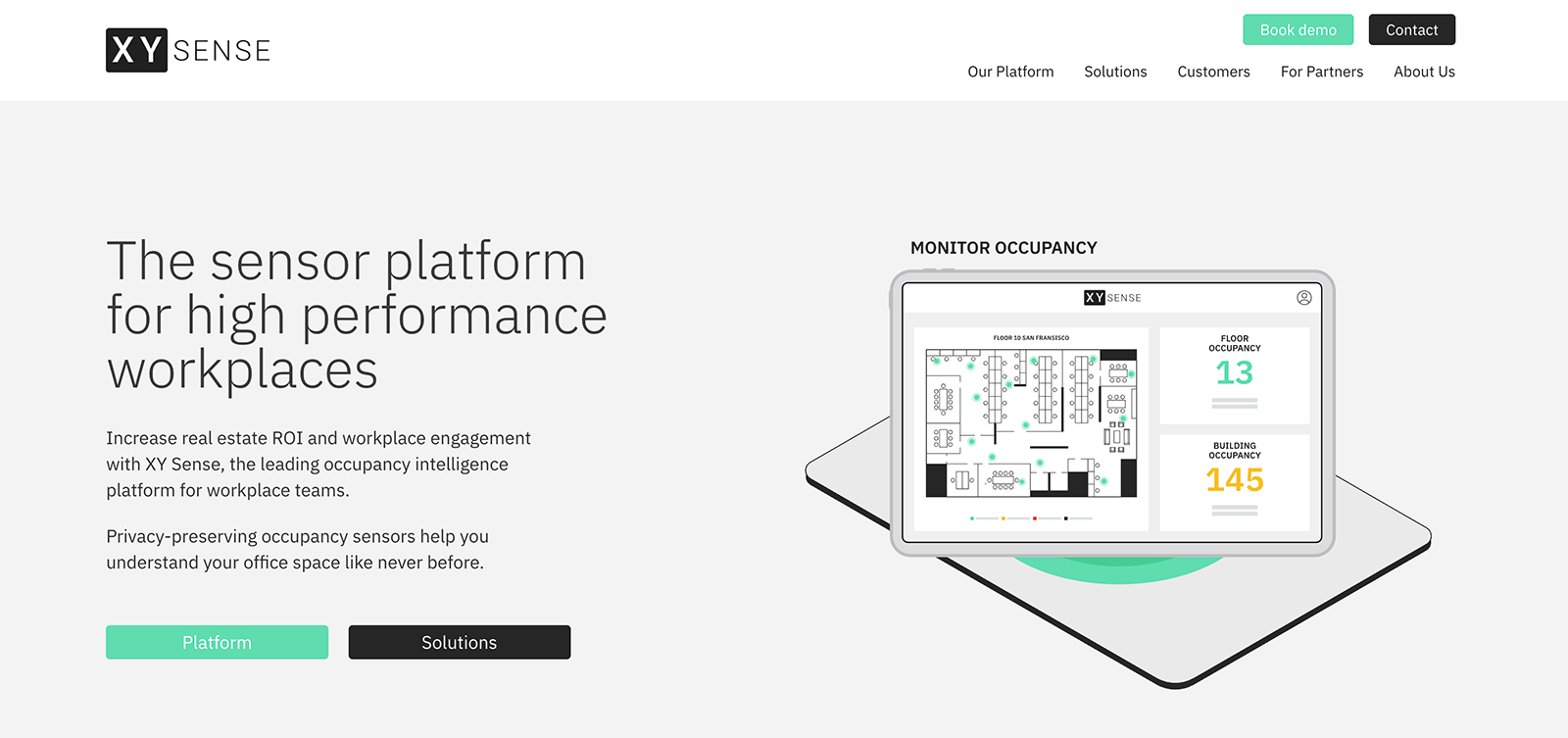
XY Sense is a workplace analytics platform that uses ceiling-mounted sensors and computer vision to capture XY coordinate data about how spaces are used. It offers sensors for open areas, meeting rooms, entry points, and smaller spaces like phone booths, along with a wireless passive infrared (PIR) presence sensor for compact rooms. The platform is designed around workplace experience use cases like hybrid planning, agile workspace design, and portfolio optimization.
XY Sense vs VergeSense at a Glance
Pros
- Includes integrated air quality monitoring through third-party sensor partnerships, combining environmental and occupancy data in one platform.
- Offers a live replay feature that visualizes real-time movement patterns, which can help teams validate how spaces are actually being used.
- The small spaces sensor is wireless and stick-on, making it easier to deploy in compact rooms and around movable furniture without a wired install.
Cons
- Deployments commonly rely on partial or sampled coverage, which can leave gaps in portfolio-wide visibility.
- Teams that rely on external tools for space planning or operations may need to do more work to get data out of the platform and into their existing workflows.
- Core sensors are ceiling-mounted and wired, which can add complexity and cost to large-scale or multi-site rollouts.
Pricing
Custom pricing available upon request.
Avuity
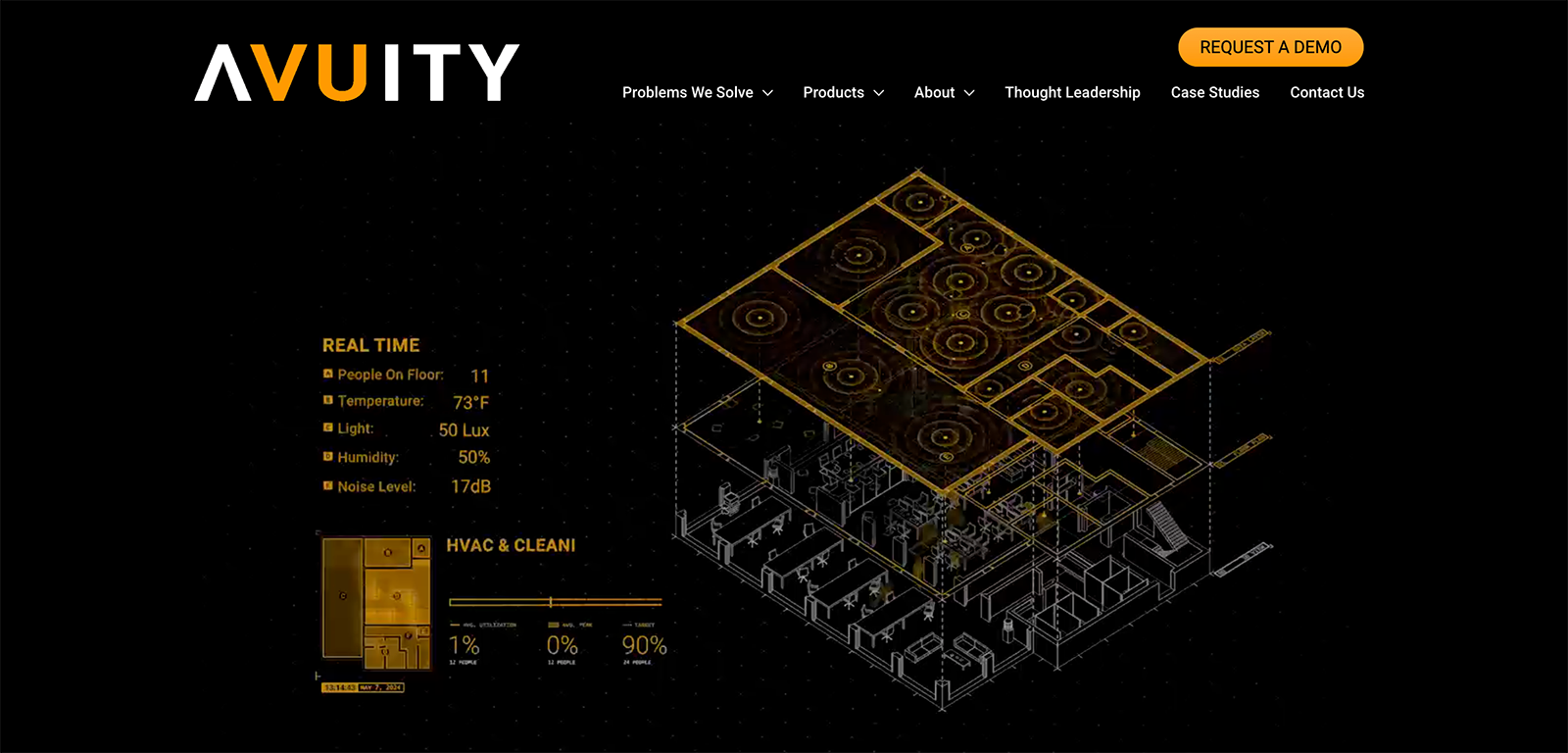
Avuity is a camera-free occupancy sensing platform focused on room and space presence detection. Its primary sensor uses AI and machine learning to capture occupancy, headcount, and environmental data like temperature, humidity, light, and noise. It's a fit for organizations that need straightforward space availability data and booking accuracy, with optional integrations for HVAC and cleaning optimization.
Avuity vs VergeSense at a Glance
Pros
- Captures environmental data (temperature, humidity, light, noise) alongside occupancy, which can support HVAC optimization and workplace comfort initiatives from a single sensor.
- Camera-free by design, which can simplify privacy conversations and speed up approvals in sensitive environments.
- Includes a mobile app and room booking tool, adding an employee-facing layer that some occupancy platforms don't offer.
Cons
- Primarily focused on room-level presence detection, which may not provide the spatial detail needed for open floor plans, traffic flow analysis, or peak demand insights.
- Getting occupancy data into external systems like IWMS or BI tools may require more effort, since the platform is oriented around its own reporting layer.
- Doesn't hold SOC 2 or ISO 27001 certifications, which can slow down procurement for enterprise buyers with strict InfoSec requirements.
Pricing
Custom pricing available upon request.
Pointgrab

PointGrab is an AI-powered occupancy analytics platform that combines optical and PIR sensing in a single ceiling-mounted unit. Its sensors capture occupancy counts, movement patterns, object detection, and virtual traffic lines, with integrations into building automation systems for HVAC, lighting, and energy management. It's designed for teams managing select high-value office spaces where zone-level spatial data can drive both workplace optimization and building operations.
PointGrab vs VergeSense at a Glance
Pros
- A single sensor covers occupancy, motion, object detection, and traffic counting, which can reduce the total number of devices needed across a deployment.
- Designed to be software-agnostic, with a REST API and emphasis on feeding data into third-party applications rather than locking it behind a proprietary dashboard.
- The newer wireless sensor can be installed in occupied offices and moved between spaces, adding flexibility for teams that need to reconfigure coverage over time.
Cons
- The core wired sensor requires calibration and heavier installation, which can slow deployment timelines and increase upfront cost.
- Uses optical sensing, so privacy mitigations and review processes may still be required, particularly in regions with strict data protection regulations.
- Typically deployed in selective areas rather than full portfolios, which can limit visibility into organization-wide space usage patterns.
Pricing
Custom pricing available upon request.
Consider The Occupancy Sensor Platform That Prioritizes Privacy and Scale
The platforms in this comparison each take a different approach to occupancy sensing. But if your priority is getting accurate data fast, across a large or distributed portfolio, without privacy friction or vendor lock-in, Butlr is worth a closer look.
Here's why teams choose Butlr over VergeSense:
- Deploy in days, not months: Wireless, battery-powered sensors install at scale without electricians, calibration, or drawn-out rollout phases.
- Zero privacy risk at the hardware level: Butlr's thermal-only sensing means the hardware physically can't capture images, biometrics, or personal data. Legal and IT approvals move faster when there's nothing to review.
- Scale globally without bottlenecks: No camera approvals to repeat at every site means rollouts across regions with different data protection laws and labor norms stay on schedule.
- Data goes where you need it: Butlr's API-first architecture pushes real-time occupancy signals into IWMS, BMS, energy, cleaning, and BI tools rather than keeping them locked in a proprietary analytics layer.
- More coverage for less: Lightweight hardware and fast installs mean teams can instrument entire buildings and portfolios at a lower total cost than platforms that require heavier infrastructure.
Request a demo to see how Butlr helps teams make faster, better-informed decisions about their workplace portfolios.


.webp)