


.svg)


VergeSense vs Density vs Butlr Compared Head-to-Head
VergeSense, Density, and Butlr are three of the most well-known platforms in the workplace occupancy space, but they take fundamentally different approaches to sensing technology, privacy, deployment, and integration. Those differences matter more than most buyers realize, especially when you're planning to scale across a multi-building or global portfolio.
Before we get into a deeper comparison, here's a quick summary of who each platform may be best suited for:
- VergeSense: Best for teams that prioritize rich analytics, benchmarking reports, and long-term space planning, and are comfortable navigating the privacy review process that comes with camera-based sensors.
- Density: Best for organizations that want a vertically integrated analytics dashboard (Atlas) and are focused primarily on office-centric use cases with controlled ceiling environments.
- Butlr: Best for enterprise teams that need fast, privacy-safe deployment across large or complex portfolios, with occupancy data that feeds directly into existing workplace platforms via an API.
With that, let's walk through each platform's key features, advantages, and shortcomings, then compare them head-to-head across the categories that matter most when evaluating occupancy sensors.
VergeSense Overview
VergeSense is an occupancy sensing platform that uses camera-based sensors and computer vision to detect how people use workspaces. The sensors capture raw visual data, process it on-device using edge compute (meaning all analysis happens on the sensor itself rather than in the cloud), and transmit only anonymous, text-based outputs. All of that data feeds into Meridian, an analytics platform built for space planning and portfolio-level reporting.
Key Features
- Meridian Analytics Platform: Meridian offers retrospective analysis at the building, floor, and individual space level, and can pull in data from other sources alongside VergeSense sensor readings.
- Camera-Based Sensing with Edge Compute: The sensors use computer vision to detect and count people, then process the raw data locally so no images leave the device. Only text-based results are transmitted.
- Multi-Source Data Ingestion: VergeSense can combine sensor data with signals from existing building systems, giving workplace teams a more complete picture of occupancy without relying on a single data source.
Advantages
- VergeSense is a single platform that helps workplace teams make portfolio decisions, not just collect occupancy data. The platform is built to support use cases like right-sizing, lease evaluation, and space reallocation.
- Camera-based sensing with computer vision can distinguish between people and objects, which adds a layer of context that not all VergeSense alternatives provide.
Shortcomings
- The sensors use cameras, which can trigger legal, IT, and works council reviews that add weeks or months to deployment timelines, especially outside the US. When looking at the raw data captured by the camera, it is possible to identify individuals.
- Each sensor requires careful placement and calibration, so large-scale rollouts take longer than wireless alternatives.
Density Overview
Density is an occupancy sensing platform that uses 60GHz radar and depth sensing to count people and track how spaces are used. Instead of cameras, the sensors emit radar waves that detect presence and movement without producing images. The data feeds into Atlas, a proprietary analytics dashboard where customers can view utilization metrics, trends, and portfolio-level comparisons.
Key Features
- Atlas Analytics Dashboard: Atlas shows real-time occupancy, historical utilization trends, and heatmaps of how people move through a space. Teams can compare performance across floors and buildings, label spaces by function, and export reports for stakeholders.
- Radar-Based Sensing: The sensors use radar to detect and count people without capturing images. This approach is anonymous by design, since the sensors have no camera or lens.
- Spatial Detail in Open Areas: Density's open-area sensors cover up to roughly 1,000 square feet per unit and can capture movement paths and flow patterns, which can be useful for teams making layout and space design decisions.
Advantages
- Density's radar-based approach avoids the most common privacy objection in the occupancy space, since the sensors don't capture images, which simplifies conversations with legal and IT teams.
- Atlas provides a self-contained analytics experience, so teams that want a turnkey dashboard don't need to build custom reporting from scratch.
Shortcomings
- Some Density sensors require Power over Ethernet (PoE), which means running ethernet cable to each device. That adds cost, coordination, and time to deployments, particularly in older buildings or large-scale rollouts.
- While API access is available, integrations with external systems like integrated workplace management systems (IWMS), building management systems (BMS), and cleaning platforms aren't the main focus.
Butlr Overview
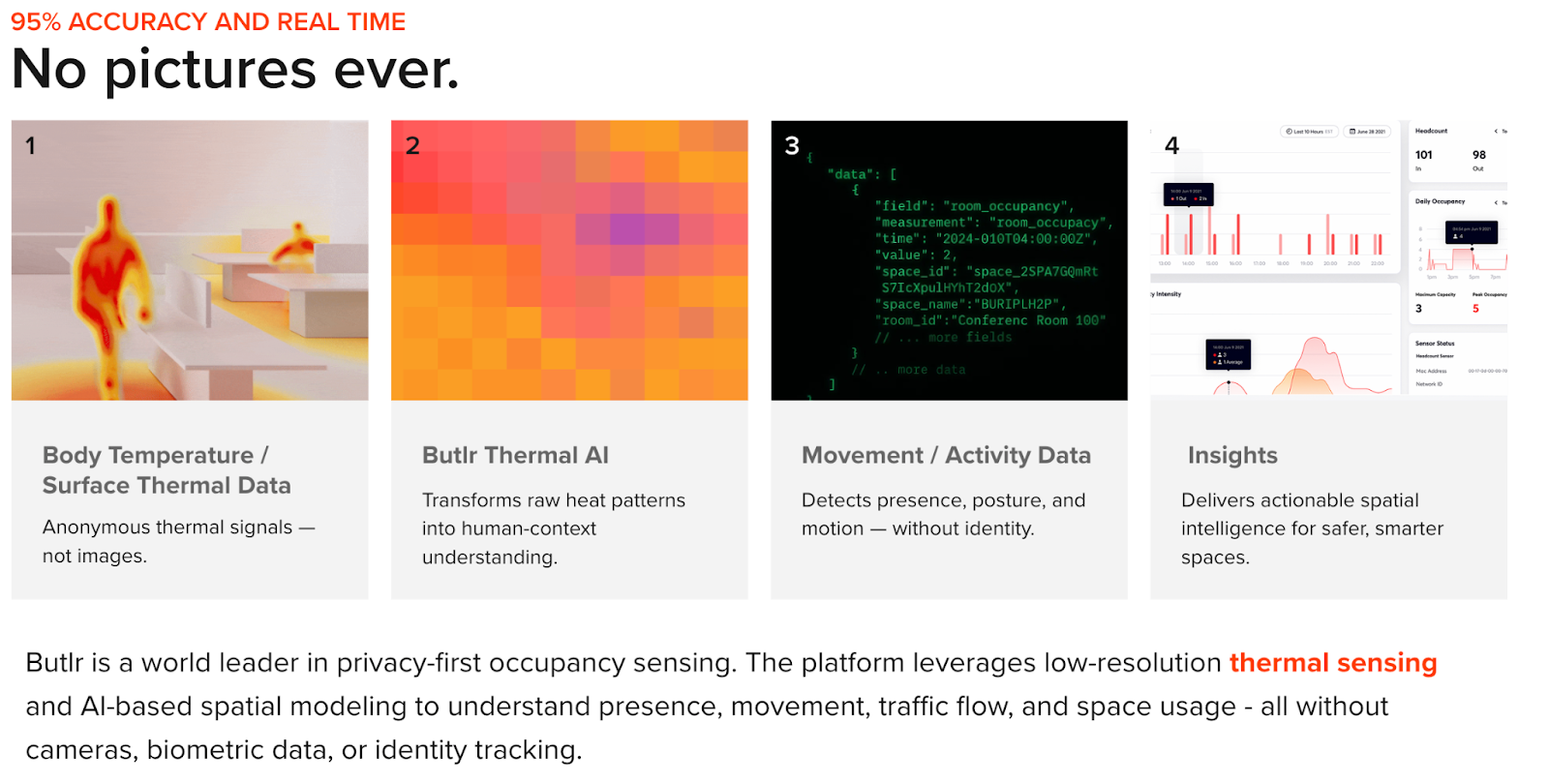
Butlr uses thermal sensing to give enterprise organizations a clear, anonymous picture of how space is used across a portfolio. The sensors read heat energy only, which means they are incapable of producing images or identifying anyone. The platform currently covers 100 million+ square feet across 22+ countries, with more than 30,000 sensors in the field.
Here's what sets Butlr apart.
1. Anonymity is built into the sensor
Other occupancy platforms handle privacy through software controls or on-device processing. Butlr removes the issue entirely: the sensor has no camera, no lens, and no way to generate personally identifiable information (PII). There's no data to scrub or govern because it was never captured in the first place.
That hardware-level guarantee is what allows Butlr to operate in types of spaces that are off-limits to camera and radar-based systems, from bathrooms to patient rooms to research labs. The platform holds SOC 2 Type II certification, and because no PII exists in the data pipeline, legal and information security (InfoSec) teams can complete reviews in a fraction of the time.
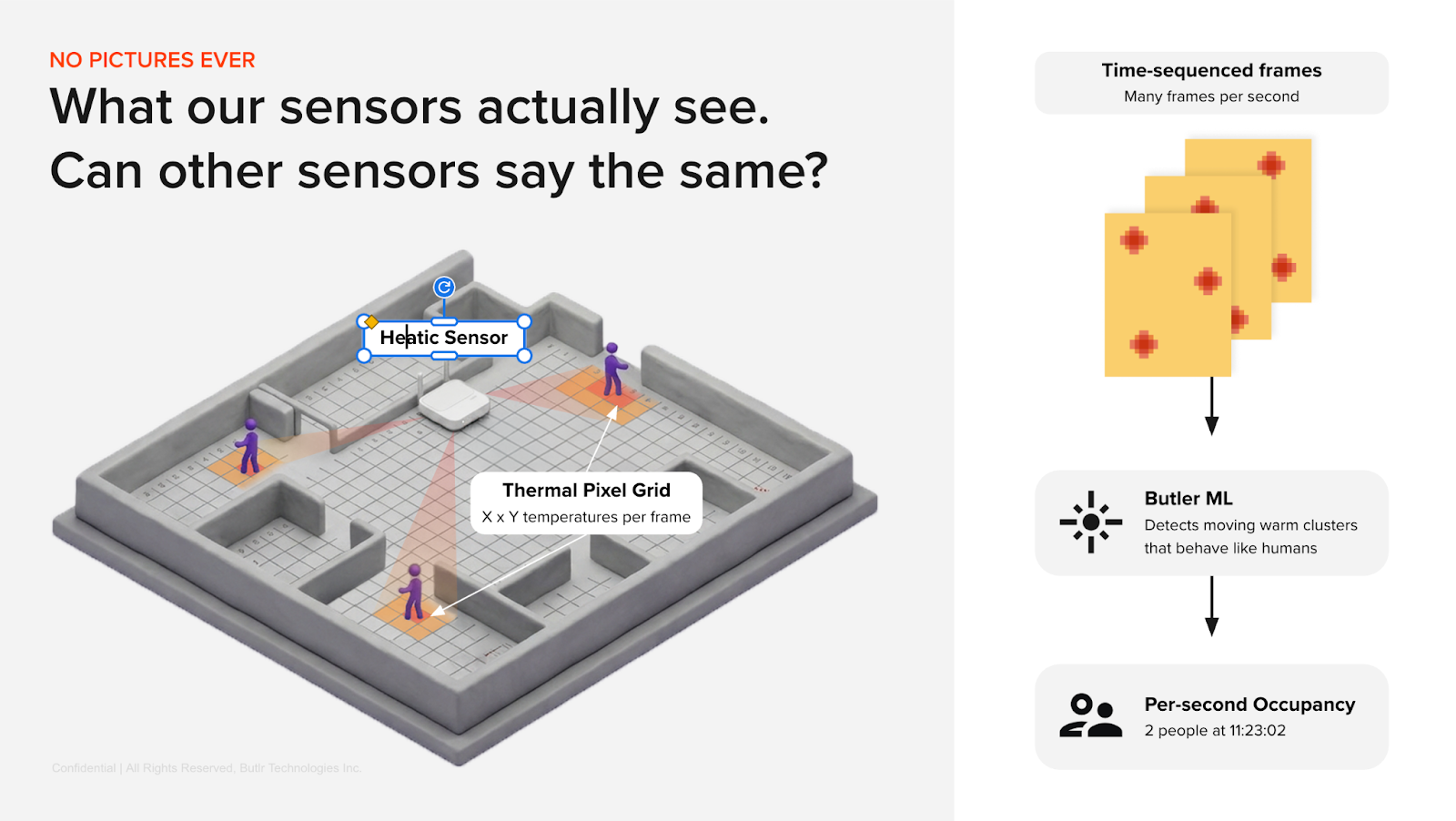
2. Richer data than legacy motion sensors
Unlike standard passive infrared (PIR) motion sensors that only detect whether a space is occupied or vacant, Butler’s thermal array sensors capture far more detail. Sensors record headcount, position within the room, how long people stay, and how they move through a space.
That level of detail lets a facilities manager spot patterns like consistently oversized meeting rooms and act on them, whether that means reconfiguring a floor plan or reallocating square footage to better-used areas.
3. Occupancy data feeds into your existing systems
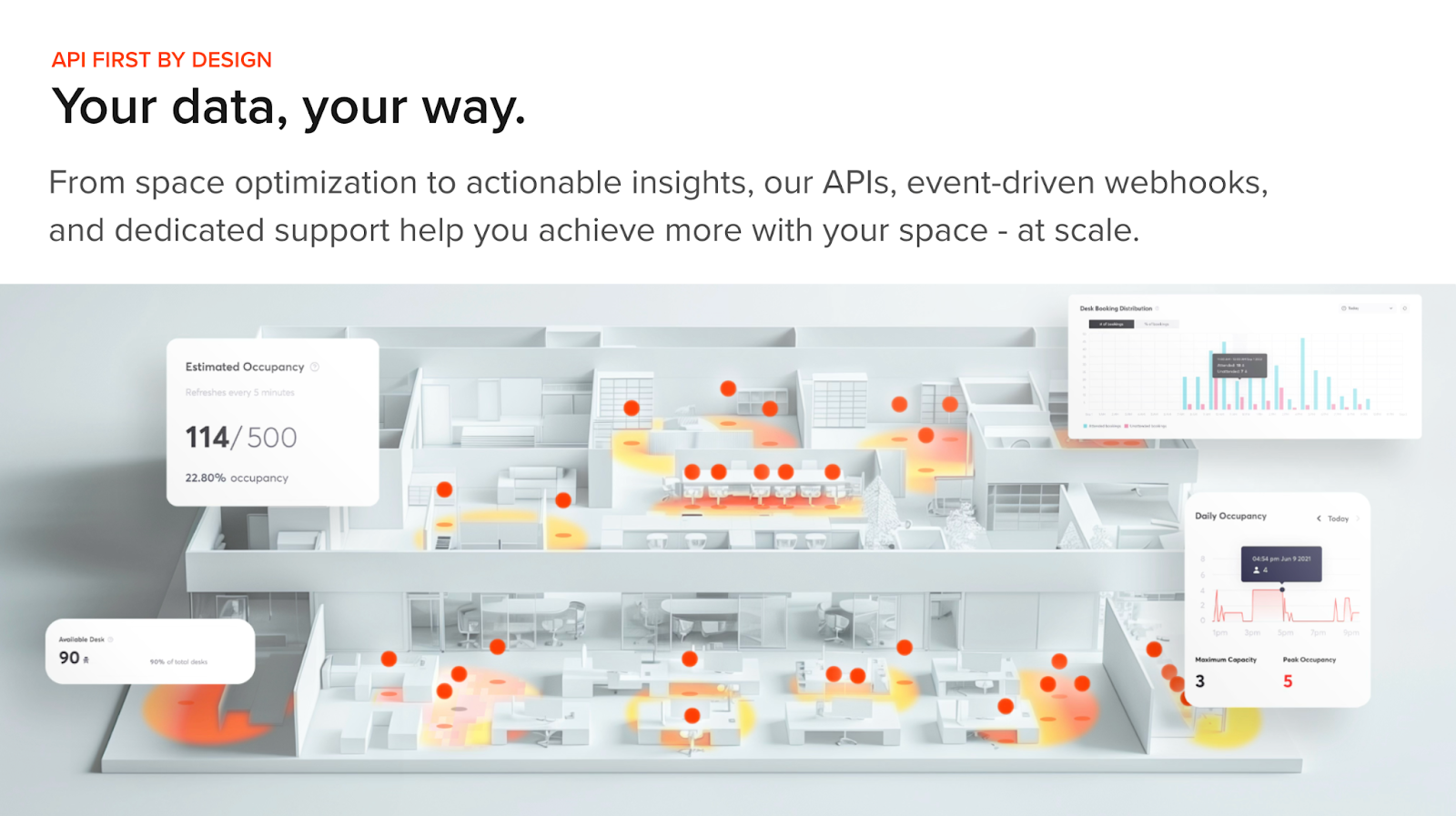
Butlr is designed to work with the platforms your organization already runs on. The platform connects to IWMS, BMS, HVAC controls, BI tools like Tableau and Power BI, CMMS, and energy management software through REST APIs and event-driven webhooks.
That means facilities employees can route occupancy signals into a cleaning platform, energy managers can tie HVAC schedules to real room usage, and commercial real estate directors can layer sensor data into lease analysis without switching between tools.
4. Fast installation with flexible connectivity
Butlr sensors run on batteries and connect wirelessly, so there's no need to pull cable or schedule an electrician. The gateway offers three connectivity options (WiFi, cellular, and ethernet), so you can roll out across buildings with different network setups without redesigning the approach at each site. A large deployment can be up and collecting data in a matter of days, not months.
Each sensor also operates in two modes. In presence mode, it tracks how many people are in a defined area and where they're positioned in real time. In traffic mode, it counts directional movement through a doorway or threshold. That dual capability means one device type can serve use cases from desk-level utilization to building-level foot traffic.
Advantages
- Butlr’s thermal sensors are anonymous at the hardware level, which removes the most common barrier to large-scale occupancy deployments: privacy review timelines. Because no PII ever enters the data pipeline, legal and InfoSec approvals that take weeks or months with camera or radar-based systems can often be completed in days.
- The wireless, battery-powered form factor means sensors can be installed across hundreds of rooms overnight with no wiring, electricians, or IT coordination. That speed advantage compounds at portfolio scale, where traditional sensor rollouts can stretch across quarters.
- Butlr’s API-first architecture is designed to push occupancy data outward into the systems your teams already use, from IWMS and BMS platforms to BI dashboards and cleaning software. Rather than requiring your team to learn a new analytics tool, the data goes where the decisions are already being made.
Shortcomings
- Because Butlr is API-first, the platform relies on data flowing into external tools rather than offering a single built-in analytics dashboard on par with VergeSense’s Meridian or Density’s Atlas. Teams that want a turnkey, all-in-one reporting experience may need to pair Butlr with a BI or IWMS platform to get the visualization layer they’re looking for.
- Like all thermal sensing technology, performance can be affected by strong ambient heat sources such as direct sunlight on a sensor or industrial heating equipment nearby. Proper sensor placement during installation accounts for this, but it’s a factor worth noting during site surveys.
Comparing VergeSense, Density, and Butlr Head-to-Head
Sensor Technology
VergeSense uses AI-powered camera-based sensors with computer vision and edge compute. Density uses 60GHz radar with depth sensing to anonymously count people. Butlr uses thermal sensors that detect only heat signatures, capturing occupancy and movement without any visual or radio-frequency imaging.
The Takeaway: If your priority is accurate data with zero risk of identifying individuals at the hardware level, thermal sensing is the most conservative approach.
Connectivity Options
VergeSense's standard sensor is wireless and battery-powered, connecting through a proprietary mesh network to a gateway. Some Density sensors require PoE for connectivity. Butlr sensors are wireless and battery-powered, connecting through a gateway via WiFi, cellular, or ethernet to the cloud.
The Takeaway: For large or complex deployments, fully wireless options reduce coordination with IT and facilities teams while maintaining the footprint you need.
Anonymous Data Capture
VergeSense uses cameras but processes data on-device, transmitting only text-based outputs with no images stored. Density's radar sensors don't capture images and can't interpret PII. Butlr's thermal sensors give you the full picture of your office space without capturing images, biometrics, or individual signatures at the hardware level.
The Takeaway: All three platforms approach anonymity differently, but Butlr is the only one where the sensor itself makes identification impossible, which shortens compliance review timelines and reduces the need to handle any PII.
Installation Timeline
VergeSense deployments are typically phased, with camera placement requiring planning and calibration. Density's wired sensors require PoE infrastructure, which can extend timelines in buildings without existing cabling. Butlr's sensors can be installed overnight in large quantities with no wiring or electricians, and teams typically have data flowing within weeks.
The Takeaway: For organizations on tight timelines, Butlr offers the fastest path from purchase to actionable data.
Security
VergeSense is SOC 2 Type II certified, ISO 27001 certified, and GDPR compliant, with data encrypted using TLS 1.2. Density manufactures sensors in-house and emphasizes full control over device software. Butlr is SOC 2 Type II certified, and because the sensors never handle PII, the security surface is narrower by default.
The Takeaway: The less data a sensor collects, the smaller the attack surface and the simpler the compliance process.
Integrations
VergeSense supports API access for data export alongside Meridian's built-in analytics, with integrations typically mediated through the platform. Density is optimized around Atlas, with integrations that extend the dashboard experience. Butlr offers dozens of native integrations and feeds data outward via REST APIs and webhooks into IWMS, BMS, BI, energy, CMMS, and cleaning systems.
The Takeaway: If your team already has a workplace tech stack and needs occupancy data embedded across it, an API-first platform will save significant time.
Price
VergeSense falls in the mid-to-high range ($$$), reflecting the cost of camera-based hardware and the Meridian analytics platform. Density is the most expensive option ($$$$), with wiring requirements and professional installation adding to total cost of ownership. Butlr is the most affordable ($), with wireless sensors and minimal installation overhead that keep both upfront and ongoing costs low.
The Takeaway: When evaluating cost, factor in more than the per-sensor price. Wiring, professional installation, and ongoing maintenance can significantly increase the total investment over time.
Which Platform Should You Choose?
After comparing these three occupancy sensing platforms across technology, privacy, deployment speed, integrations, and cost, the right choice comes down to what your organization values most and where you plan to scale.
Choose VergeSense if your primary goal is detailed retrospective insights and industry benchmarking, and your legal and IT teams are prepared to review camera-based sensing. VergeSense's Meridian platform offers strong reporting capabilities, but keep in mind that camera-based deployments often require longer rollout timelines and additional privacy approvals, particularly outside the US.
Choose Density if you want a self-contained analytics experience through their Atlas dashboard and your deployments are focused on well-controlled office environments with optimal ceiling heights. But be aware that Density's radar-based approach may still raise questions with InfoSec teams in certain regions, and the platform-centric model may limit how easily occupancy data flows into your existing tech stack.
Choose Butlr if you need to move fast and scale across a large, complex, or global portfolio without getting slowed down by privacy reviews, wiring requirements, or platform lock-in. Butlr's thermal sensors are physically anonymous (no images, no PII, no cameras), wireless and battery-powered for rapid installation, and built API-first so data flows directly into the IWMS, BMS, energy, and cleaning systems your team already relies on.
For organizations evaluating occupancy intelligence at enterprise scale, the deciding factors often come down to deployment speed, privacy clearance, and integration flexibility. If those are priorities for your team, request a demo of Butlr to see how thermal sensing performs across your specific building types and use cases.


.webp)