


.svg)


How Occupancy-Based Cleaning Cuts Waste & Saves Money
Facilities teams are paying to clean spaces that nobody used today. In a hybrid workplace where occupancy can swing from 80% on a Tuesday to 30% on a Friday, a fixed cleaning schedule means crews are servicing empty conference rooms and barely-used floors on the same rotation as high-traffic restrooms and lobbies.
We see the numbers back this up. In a Butlr survey of 400 U.S. building and facilities decision-makers, 66% said they clean all areas with the same frequency regardless of actual use, and 82% reported that their cleaning schedules aren't built on occupancy data.
Occupancy-based cleaning replaces this blanket approach with one grounded in how spaces are actually used. This article walks through where fixed schedules fall short, how usage-driven cleaning works, and what it looks like when you put it into practice.
The Problem with Fixed Cleaning Schedules
Fixed cleaning schedules were designed for a world where buildings were full five days a week and usage was roughly predictable from one day to the next. Hybrid work patterns broke that assumption. Daily occupancy now fluctuates dramatically, and the cleaning operation hasn't adjusted to match.
The waste runs in both directions.
On the over-cleaning side, crews are vacuuming empty floors, wiping down untouched desks, and restocking supplies that weren't consumed. That's labor hours and consumables spent on spaces where nobody sat down. On a quiet Friday in a 15-floor office building, half the building may see zero foot traffic, but every floor still gets the same service.
On the under-cleaning side, the busiest spaces aren't getting proportionally more attention. The restrooms closest to a company cafeteria or the conference rooms that run back-to-back meetings all day are on the same rotation as a quiet wing on the sixth floor. When occupancy spikes, those high-use areas don't get extra passes. They just get dirtier.
Restrooms are the clearest example. Across a portfolio, restroom demand can vary by a factor of 8x, and traffic can drop nearly 80% from Tuesday to Friday. Yet most schedules treat every restroom the same way, every day of the week.
In Butlr's survey, 60% of facilities decision-makers said they believe better data on cleaning costs could yield measurable savings. Most buildings on a fixed schedule are spending more on cleaning than actual usage would justify.
How Occupancy-Based Cleaning Works
Occupancy-based cleaning uses real-time data about how spaces are actually used to determine what gets cleaned, when, and how thoroughly. Instead of time-based triggers (clean every restroom every two hours), it relies on usage-based triggers.
At a high level, the approach works like this:
- Sensors detect foot traffic, occupancy, or presence in specific zones across the building.
- That data feeds into a dashboard or cleaning management system.
- When usage crosses a defined threshold, the system flags that space for cleaning.
- Spaces with low or no usage get deferred to a lighter service cycle.
This applies across the full workplace. Conference rooms, open office neighborhoods, lobbies, breakrooms, and common areas all benefit from the same logic. Spaces that sat empty can move to a lighter service cycle, while heavily used areas can get attention sooner than a fixed schedule would allow.
Cleaning moves from a fixed calendar to a responsive, data-informed workflow. Crews spend their time on spaces that need attention, and the building stays cleaner in the places people actually use.
What This Looks Like in Practice: Butlr's Smart Cleaning
Butlr's Smart Cleaning solution uses thermal sensors that detect body heat rather than identities. There are no cameras, no personally identifiable information (PII), and no device tracking. This is especially important in privacy-sensitive spaces like restrooms and wellness rooms, where camera-based or device-based sensors can't be deployed.
The same sensor hardware operates in two modes. In traffic mode, it counts the number of people entering a space. In presence mode, it detects whether a space is currently occupied. A single deployment covers different use cases across the building without swapping hardware.
How the workflow runs day-to-day
- Count. A traffic sensor mounted at the entrance counts real people, not proxies or estimates.
- Threshold. Usage is measured against a per-space limit or a max-time hygiene guardrail. Both are customizable per space.
- Alert. When the threshold is crossed, cleaners get notified directly by SMS or email. No new app is required.
- Clean. The space gets serviced within the existing workflow. Response time is tracked.
- Confirm. A touch button press resets the counter and logs the completed clean.
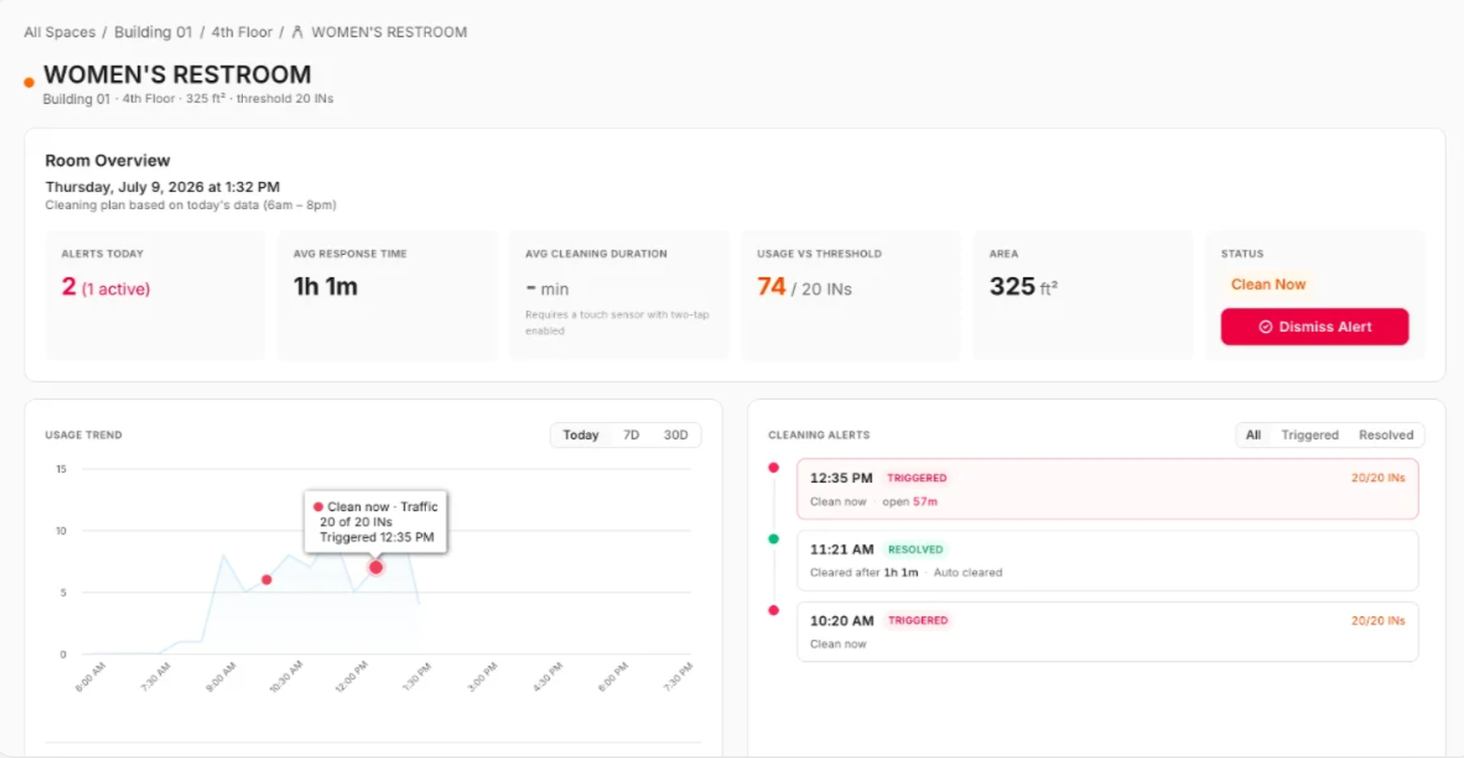
This workflow gives facilities teams several useful capabilities:
- Live cleaning states per space, updated continuously from real usage data.
- Hygiene guardrails that ensure no space exceeds a configurable maximum time between cleans, even on low-traffic days.
- Auditable clean history with a full log accessible via dashboard and CSV export, useful for compliance reporting and vendor accountability.
- True people counts from the entrance, so the data is accurate even in doorless or airport-style restrooms.
Because the sensors read thermal signals rather than images or identities, the system can be deployed in spaces where cameras or badge readers aren't appropriate or legal. There is no PII to manage, encrypt, or accidentally expose. Privacy is a hardware-level feature, so there are no software-layer controls to configure or maintain.
Learn more about Butlr's Smart Cleaning and workplace occupancy solution.
The ROI of Switching
The business case for occupancy-based cleaning is straightforward to quantify. Based on Butlr customer data (annual averages):
- $1,400 in savings per restroom per year.
- 1,200 hours of cleaning effort redirected to spaces that actually need it.
- 15,000 gallons of water saved through occupancy-driven scheduling.
Beyond cost reduction, there are secondary benefits that compound over time. High-traffic areas stay cleaner, and occupant complaints drop.
Every clean is logged with a timestamp for easier SLA reporting and vendor management. And reduced water and supply consumption feeds directly into ESG and sustainability metrics.
Making The Switch
For facilities teams managing hybrid-era portfolios, the shift from fixed schedules to occupancy-based cleaning starts with understanding how your spaces are actually used.
Let's talk about what occupancy-based cleaning could look like in your buildings.
.png)

%20(1).png)
.png)
.webp)