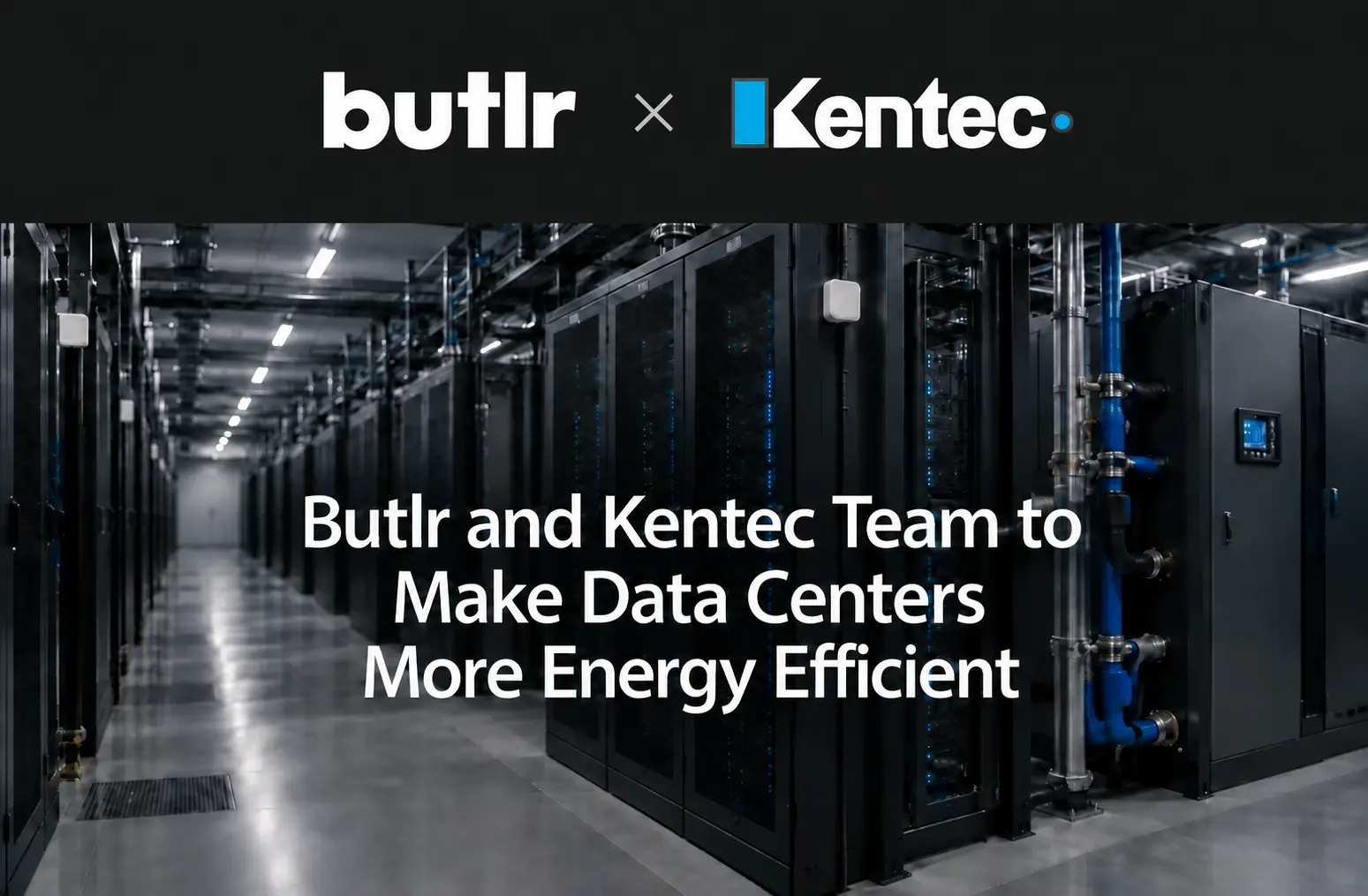
Butlr and Kentec Team to Make Data Centers More Energy Efficient


PR
DAte
October 20, 2026
Share


Burlingame, CA – October 13, 2026 – Butlr, a leader in physical AI (PAI) technology and Kentec, a leader in AI-powered liquid cooling technologies today announced a strategic partnership designed to make data centers more energy efficient.
Butlr, an MIT Media Lab spinout, has patented the combination of AI and thermal sensing technology to anonymously understand how space is used and if a building is optimized for energy efficiency. In data centers, Butlr thermal sensors provide accurate, real-time insight on energy consumption and heat output. This provides faster responses to issues such as overheating or potential fires that would otherwise go unrecognized by the human eye until the situation is critical.
Kentec, a subsidiary of the Kenmec Group, provides end-to-end infrastructure, high-performance liquid cooling, and turnkey engineering solutions for AI and high-performance computing data centers.
Together, the companies provide a powerful, cost-effective way to optimize data center computing power while proactively identifying and addressing high demands for energy driven by AI.
Butlr and Kentec Demonstrate Capabilities at Tatung
Kentec’s AI compute container equipped with the Butlr thermal sensor and control function was demonstrated at Taiwan power equipment and electromechanical integration company Tatung as part of its modular AI data center solution. Tatung aims to compress the traditional two-to-three-year data center build cycle down to 180 days to compute go-live.
The solution pre-integrates compute racks, power distribution, cooling and intelligent monitoring into standard 20-foot and 40-foot high-cube containers, and on-site piping and rack assembly can be completed within four weeks of arrival. Performance is guaranteed at a power usage effectiveness (PUE) below 1.25 and Tier 2 or higher reliability.
According to Tatung, its demonstration site already runs two cooling systems, with medium-voltage power supply, transformers and switchgear all of its own make, covering both air-cooled and liquid-cooled racks, with liquid cooling designed for NVIDIA's next-generation Vera Rubin platform. The product targets enterprise self-built compute and data center operators in the 0.5MW to 50MW range and offers high-voltage power and liquid-cooling integration to Taiwan server ODMs.
How Butlr Lowers Data Center Power Demand
Butlr’s Heatic thermal sensors for data centers address the heat loads generated by AI. These workloads shift by rack and zone in ways that can be hard to anticipate, making it challenging to determine which zones are generating the most heat from those sitting idle. In response, the HVAC systems are programmed to constantly cool everything at the level required by its highest-demand assumptions. This leads to chronic overcooling and significant wasted energy.
Thermal sensors solve this issue by detecting surface temperature and translating it into location, occupancy and activity data at the zone level. Connecting Butlr sensors throughout a data center enables them to become part of the building’s “nervous system,” or DNA.
Providing a real-time picture of thermal conditions that were previously unavailable, Butlr sensor data makes it possible to be more responsive to immediate needs and spot longer-term trends before they lead to outages. This can improve energy efficiency by 20-30 percent by matching cooling output to actual demand rather than assumed demand.
“For data center stakeholders, being able to address today’s data center energy efficiency needs is essential. As energy demand from AI workloads grows, optimizing energy efficiency is critical to existing and future data center planning,” said Honghao Deng, CEO and co-founder, Butlr.
About Butlr
Butlr is an MIT Media Lab spinout that fuses artificial intelligence with body heat sensing technology to build patented sensors and an anonymous people-sensing platform. Using thermal insights, Butlr workplace sensor technology understands subtle movements in a space, accurately discerns activity, occupancy, indoor location, and body posture yet is purposely designed to be incapable of capturing personally identifiable information. Butlr spatial insights are used by some of the world's largest companies in hospitality, senior living, health care, commercial real estate, retail, and public transportation to inform decisions regarding space occupancy and utilization, user experiences, patient safety, compliance, staffing, and ensuring buildings are operating with high efficiency and sustainability. For more information, visit www.butlr.com.
Contact:
Kathy Keating
Butlr
kkeating@butlr.io
617-460-2702