


.svg)


4 Ways IoT Is Significantly Improving Cleaning Management
Most commercial buildings still clean every space on the same schedule, whether a restroom had 200 visitors or two. In hybrid workplaces where occupancy swings wildly from day to day, that means crews spend hours servicing empty floors while high-traffic areas wait.
The problem is a lack of usage data. Cleaning teams simply don't know which spaces were used, how heavily, or when.
IoT (Internet of Things) technology is changing this. From occupancy sensors that track foot traffic in real time to smart dispensers that report supply levels before they run out, a growing set of connected tools now gives facilities teams the usage data they need to clean based on demand rather than assumption.
This article covers four IoT technologies facilities teams are using for cleaning management today, what each one does well, and what to look for when evaluating them.
Fixed Cleaning Schedules Don't Match How Buildings Are Used
Cleaning contracts and internal schedules are usually priced for full occupancy. Every floor gets the same frequency, every restroom follows the same route, and staffing holds steady Monday through Friday. But the building that crews walk into each morning rarely matches that plan.
Average daily office utilization runs around 53%, according to CBRE's 2026 global benchmarking data. Within a single week, the range is wider still.
As CBRE's 2025 Americas Office Occupier Sentiment Survey shows, 73% of organizations report their offices run effectively at capacity on peak attendance days, while 66% report utilization below 60% on an average day. A schedule sized for the peaks overstaffs the slow days, while one sized for the average falls behind when the building fills up.
Say a building has two restrooms open on a Friday. One serves a dozen visitors, and the other several hundred. Both would get identical service if the schedule treated them equally. Or suppose a conference room that was booked but never used still got wiped down while the break room on the one crowded floor had to wait for its scheduled round.
Labor is typically the largest line item in a cleaning budget, which makes hours spent on unused floors an expensive problem. Redirecting those hours to the busy spaces can improve service without adding a single person to the crew.
IoT tools solve this by giving cleaning teams real-time usage data to act on. When a restroom crosses a preset visitor threshold, it triggers a cleaning within the hour.
4 IoT Technologies for Cleaning Management
Each of these four IoT technologies answers a different operational question. Sensors count people, dispensers report their own supply levels, equipment reports its own condition, and air monitors flag heavily used rooms.
Traffic and Door Sensors
Traffic and door sensors give cleaning teams a visitor count for each space, showing how heavily each space is used during a day or a shift. Since these sensors produce actual visitor counts, crews can prioritize based on volume and skip lightly used spaces.
Cleaning workflows usually include two main types of sensors:
- Thermal traffic sensors monitor an entry point and register the body heat of each person walking through, generating a headcount.
- Door swing sensors log the number of times a door opens and closes,treating each open-close event as a usage indicator.
The two types of smart building sensors offer different levels of precision. While thermal traffic sensors generate a true headcount, door swing sensors simply measure if the door is opened and closed. The latter works best in spaces like restroom doors or supply closets where each open-close event reflects usage.
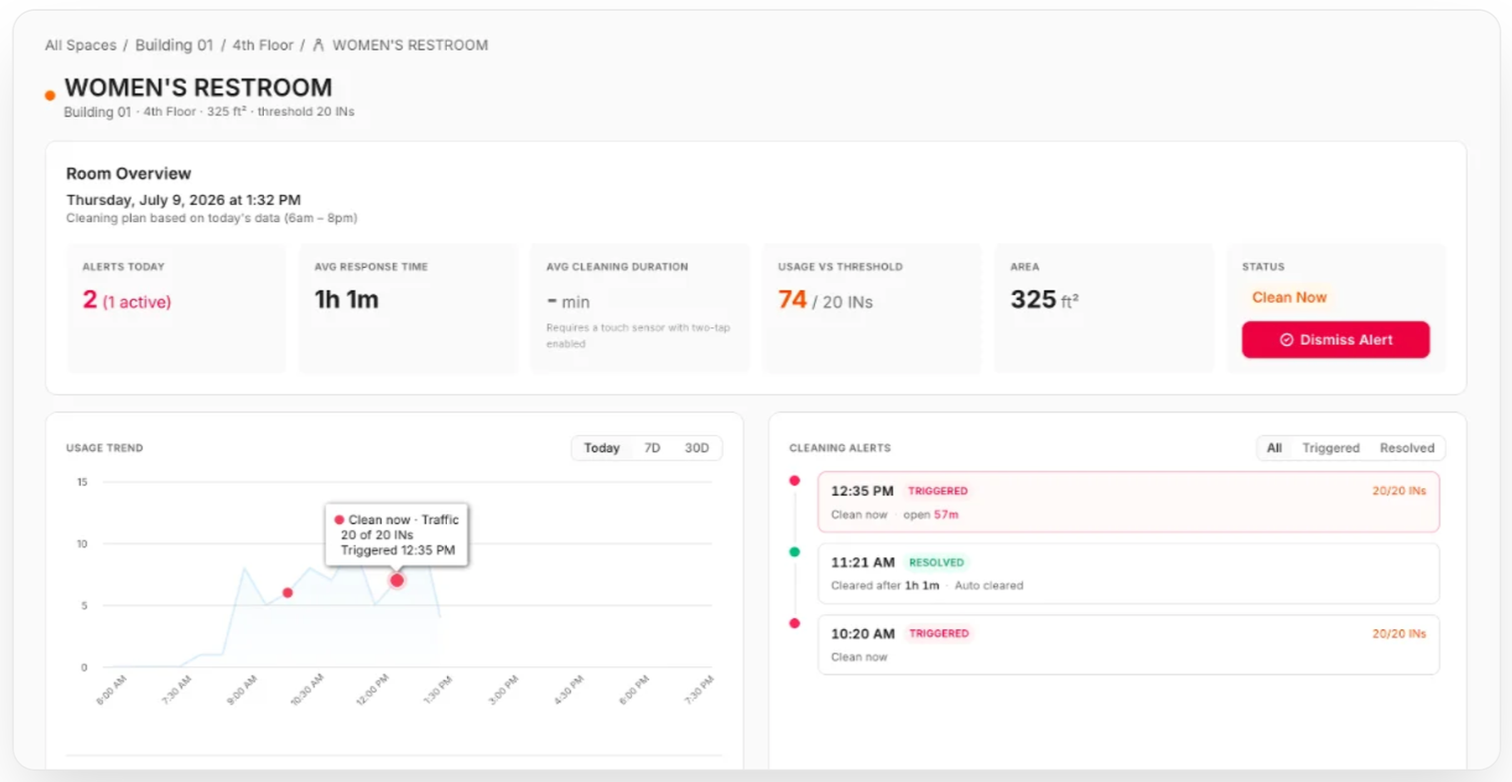
Both sensor types can push data to dashboards, cleaning management platforms, and building management systems (BMS) through an API. This allows cleaning teams to receive alerts when a space exceeds its usage threshold, telling the assigned cleaner that a restroom needs service. It also lets managers spot historical trends and determine how many cleaners each weekday warrants.
These sensors are particularly useful in restrooms, locker rooms, and healthcare settings where privacy creates a hard constraint. Cameras and Wi-Fi tracking capture personally identifiable information (PII), so either one can stall a deployment in legal or IT review. But thermal technology offers a viable alternative, as these privacy-focused sensors read body heat alone, counting traffic and presence without collecting PII.
Butlr's Smart Cleaning module is one system that combines both sensor types for restroom cleaning.
How Butlr's Smart Cleaning Module Works
Thermal sensors at each entrance count real visitors, keeping the headcount accurate even in doorless airport-style restrooms. Door swing sensors handle secondary spaces like supply closets, where an open-close count is sufficient.
Each space gets its own cleaning trigger. First is the usage threshold, a visitor count that indicates when the space needs service. Then the hygiene guardrail sets a maximum time between cleans so that low-traffic restrooms still get serviced on slow days.
These dual triggers ensure that cleaning schedules respond to both time and usage. After all, restroom demand varies 8x, dropping nearly 80% from Tuesday to Friday across a typical portfolio.
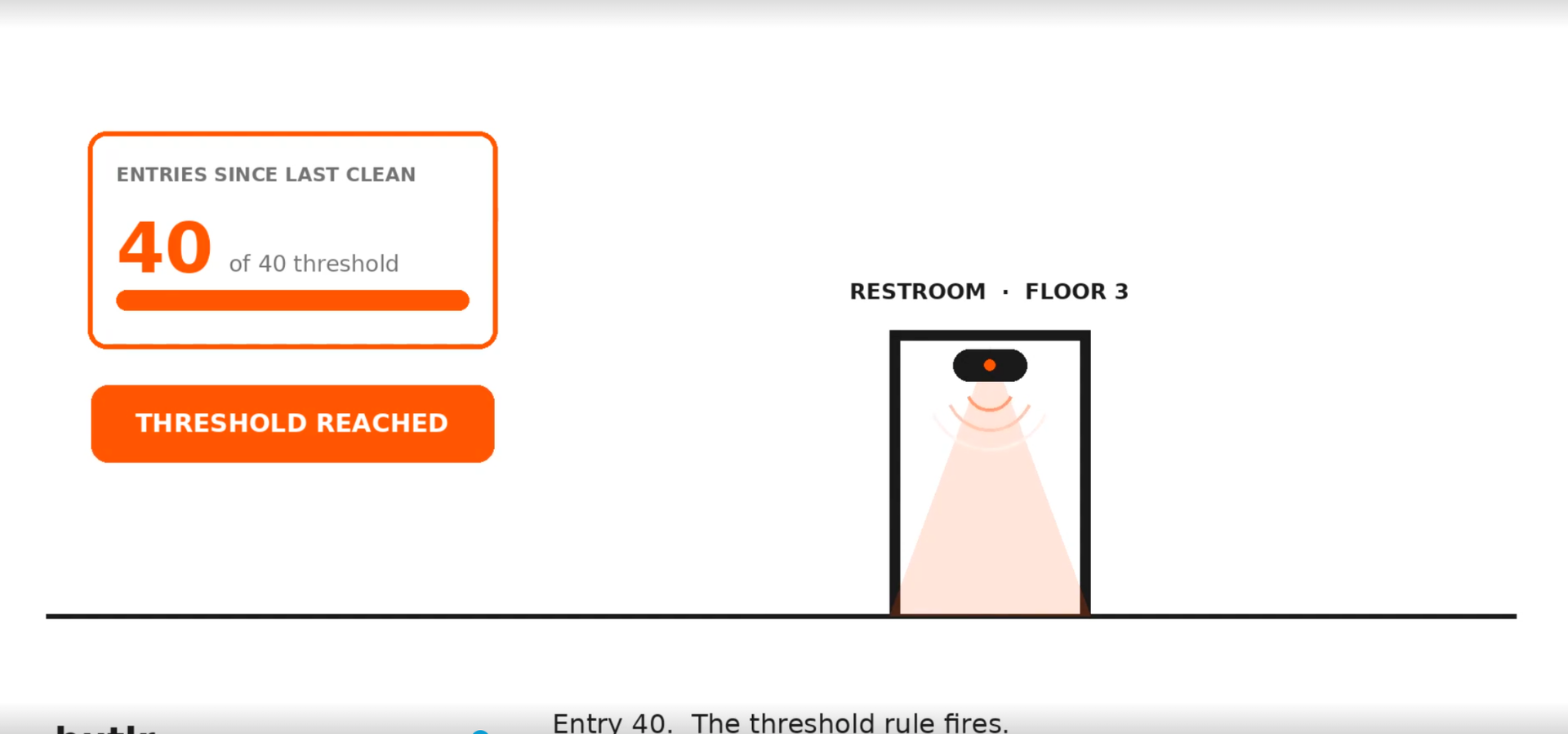
When either trigger is activated, the platform sends a text message or email to the assigned cleaner. Once they've serviced the space, the cleaner presses a touch button that resets the counter and logs a timestamped record of the clean. This approach saves an average of $1,400 per restroom each year and redirects 1,200 hours of cleaning effort to the spaces that need it most.
These records also serve as accountability tools for facilities teams with service-level agreement (SLA) obligations, automatically creating a verifiable data trail. Instead of relying on a vendor's self-reported logs or spot checks, managers can pull the response time and task duration for every alert and export the full history as a CSV file for reporting.
Learn more about Butlr's Smart Cleaning solution.
Smart Dispensers and Supply Monitoring
Smart dispensers give facilities teams real-time visibility into consumable supplies. They eliminate supply runouts between scheduled checks and replace manual checks as the sole way to identify low supply.
Fill sensors built into soap, paper towel, toilet paper, and hand sanitizer dispensers measure how much product remains, eliminating runouts between scheduled checks. Each sensor transmits readings over Wi-Fi or a cellular connection to a central dashboard. This gives facility managers a portfolio-wide view of supply levels, letting them set low-stock alerts and plan resupply routes around the dispensers that need attention.
The immediate benefits are fewer empty dispensers and fewer occupant complaints, while the longer-term benefit comes from the consumption data itself. When facilities create purchasing forecasts based on measured usage rather than estimates, they avoid over- or under-ordering supplies.
Dispenser monitoring works best when paired with occupancy data.
Say a dispenser empties twice as fast as usual one day. On its own, that reading might prompt a maintenance check. But if a traffic count shows the restroom had triple its usual visitors, the fast-emptying dispenser would simply confirm the system is working.
Connected Cleaning Equipment
Connected cleaning equipment gives facilities teams visibility into maintenance requirements. For example, commercial floor scrubbers and vacuum systems increasingly have IoT connectivity that reports runtime hours, maintenance needs, battery status, and location. Teams managing equipment across multiple floors or buildings can see where every machine is and how hard it's working.
This equipment makes predictive maintenance possible. When a machine reports its own runtime and error codes, technicians can replace parts before a failure instead of after one. Usage data also reveals which machines idle most, so managers can redeploy underused equipment to the floors that need it.
Autonomous cleaning robots also rely on IoT connectivity. Robotic scrubbers and vacuums run programmed routes, typically during off-hours, while managers monitor coverage and adjust routes remotely.
Connected cleaning equipment is ideal for repeatable tasks like corridor scrubbing and open-floor vacuuming, while detail work, private areas like restrooms, and occupied spaces still call for human crews. This makes autonomous equipment a complement to staffed cleaning rather than a replacement.
Indoor Air Quality Sensors
Indoor air quality sensors provide cleaning teams with a secondary signal. Carbon dioxide (CO2), volatile organic compound (VOC), and humidity readings all indicate how a space is being used. For instance, a CO2 spike points to heavy occupancy, while elevated VOC readings in kitchens and break rooms often trace back to food waste and garbage, signaling that the space needs cleaning before its scheduled slot.
Facilities teams typically install air quality sensors for HVAC optimization or wellness programs, so cleaning teams can often tap into readings the building already collects. Adding air quality data to occupancy and cleaning workflows helps teams spot spaces that need service between scheduled rounds.
What to Look for When Evaluating IoT Cleaning Tools
IoT cleaning tools vary widely in how they handle privacy, accuracy, and integration. Use these criteria to guide your evaluation.
Butlr's Smart Cleaning module was built to address every criterion in the evaluation above. Thermal sensors collect no PII, visitor counts are accurate to the individual, open APIs connect to existing CMMS and CAFM tools, wireless sensors install in minutes, and every cleaning event is timestamped for SLA reporting.
Learn more about Butlr's Smart Cleaning solution →
.png)

%20(1).png)
.png)
.webp)