How Predictive Fall Detection in Senior Living Works
By the time a fall alert goes off, the injury has already happened. At that point, the best a care team can do is respond quickly.
The more useful window comes earlier. In the weeks before a fall, residents often show small changes, such as more time in bed, restless nights, extra bathroom trips or a slower walk to the dining room. On a busy floor, staff rarely catch these shifts, especially overnight, and residents don’t always mention them.
Predictive fall detection tries to catch those changes while there’s still time to act. Some systems analyze sensor data from resident rooms, and others mine the clinical record. The research behind them ranges from well established to early stage.
This guide covers what predictive systems actually measure, what the evidence says, how to turn a risk signal into a care plan change, and what to ask vendors before you commit.
What Predictive Fall Detection Actually Means
The two terms get used interchangeably, but they do different jobs.
- Fall detection reacts. It identifies that someone is likely on the floor and alerts staff.
- Predictive fall detection looks upstream. It watches for changes in a resident’s behavior or health that are linked to higher fall risk, so staff can step in before a fall happens.
In practice, “predictive” means showing rising risk early enough for a nurse to take a closer look and decide what to do. These tools can’t say that a specific resident will fall on a specific day, so clinical judgment stays in the loop.
In 2020, 27.6% of U.S. adults 65 and older (about 14 million people) reported falling in the past year, according to CDC data published in MMWR. In 2023, about 41,400 older adults died from unintentional falls, according to the CDC’s National Center for Health Statistics.
The CDC’s STEADI initiative calls on providers to screen older adults for fall risk, assess the factors that can be changed, and intervene early. Predictive tools let communities run that screening continuously instead of only at periodic assessments.
The Signals That Come Before a Fall
Fall risk usually builds through small shifts across several measures, often over days or weeks. The five signals below have either the strongest research behind them or the clearest care response attached.
Mobility and Gait Changes
Slower walking speed and shorter stride length are among the most studied predictors of falls in older adults.
Some of the strongest evidence comes from TigerPlace, an aging-in-place community in Columbia, Missouri, where University of Missouri nursing and engineering researchers ran continuous in-apartment sensing for years. In a study published in the Western Journal of Nursing Research, a cumulative decline in in-home gait speed of 2.54 cm/s was linked to 4.22 times higher odds of a fall within three weeks. That’s about one inch per second, a slowdown no one on your floor would notice by watching a resident walk to lunch. The study followed 23 residents, so the finding is promising but not yet settled.
Time in Bed and Sleep Disruption
A resident who starts spending more of the day in bed may be dealing with an illness, low mood, a medication side effect or general deconditioning, and each one raises fall risk. Restless or fragmented nights add to that risk through next-day grogginess and more unassisted trips out of bed in the dark.
Night Activity and Bathroom Visits
Overnight is when staffing is thinnest and falls are most likely to go unwitnessed. A jump in bathroom visits can point to a urinary tract infection, a change in diuretic timing or a blood sugar problem. UTIs are a well-known trigger for sudden confusion and falls in older adults.
Changes in Daily Routine
Skipping meals, staying in the room more or getting up later than usual are often the changes staff recognize only in hindsight, after a fall prompts a closer look.
Clinical Record Data
Some predictive models skip sensors entirely and work from the electronic health record (EHR), using medications, diagnoses and vital signs.
A JMIR Aging study that drew on health records from 2,785 residents across Juniper Communities’ skilled nursing, assisted living and independent living settings found that a machine learning model outperformed the community’s standard fall risk assessment at predicting three-month fall risk. The number of active medications was the strongest single factor.
EHR models lag because they update when charts update, which can take weeks. Room-level sensing reflects what happened last night.
Turning a Risk Signal Into a Care Response
Communities that get value from predictive data decide ahead of time who reviews which signals and what each one should trigger.
The table below maps common signals to what they may indicate and how care teams typically respond.
| Signal | What It May Point To | Typical Care Response |
|---|---|---|
| More time in bed | Illness, low mood, medication effects, deconditioning | Nurse check-in, vitals, review of recent medication changes |
| More night activity | Pain, anxiety, sleep disruption, early delirium | Review evening routine and medications, check bed and path lighting |
| More bathroom visits | UTI, diuretic timing, blood sugar issues | Urinalysis per protocol, adjust medication timing, scheduled toileting rounds |
| Overnight bed exits without return | Confusion, wandering risk | Increase overnight rounding, assess for delirium, review room layout |
| Routine shift (late rising, skipped meals) | Decline in function, mood or health | Wellness check, flag for care plan meeting |
Responses should follow each community’s own clinical protocols. This table is a planning aid, not a clinical guideline.
Three workflow decisions determine whether trend data actually gets used:
- Name a reviewer. Assign daily trend summaries to a specific role, such as the wellness nurse or the shift lead.
- Build trends into existing routines. Add flagged changes to the shift handoff or morning stand-up so they don’t sit unread in a dashboard.
- Record what happened. Log the action taken for each flag. Over time, this shows which signals actually lead to prevented falls in your community.
How the Technology Collects the Data
Prediction depends on baselines. A system can only spot a change if it knows what’s normal for each resident, and that takes data collected continuously over weeks. If one of your residents usually sleeps through the night, four bathroom trips is worth a closer look. For a resident who has always gotten up that often, it’s just a normal night. Each technology handles this differently.
- Wearables (pendants, watches, smart insoles): Capture detailed movement data, but only while worn and charged. Residents with cognitive decline often take them off, which leaves gaps in the baseline.
- Cameras and depth sensors: Provide rich movement detail, and the TigerPlace research relied on depth sensing. Privacy concerns limit their use in bedrooms and bathrooms, which is where many falls happen.
- Radar: Camera-free and works in low light.
- Thermal sensors: Detect body heat only, with no identifiable images. They work in bedrooms and bathrooms and ask nothing of the resident.
- EHR-based models: Need no hardware, but are only as current as the chart.
The method that produces a usable baseline is the one residents and families will accept day and night in private rooms.
Where Solutions Like Butlr Care Fit
Butlr Care, currently available through pilot programs, focuses on the fall risk indicators communities can act on today, measured without cameras, wearables or anything residents need to remember.
Ceiling-mounted Butlr Heatic thermal sensors capture heat signatures only. They produce no images and collect no personally identifiable information, and installation is wired.
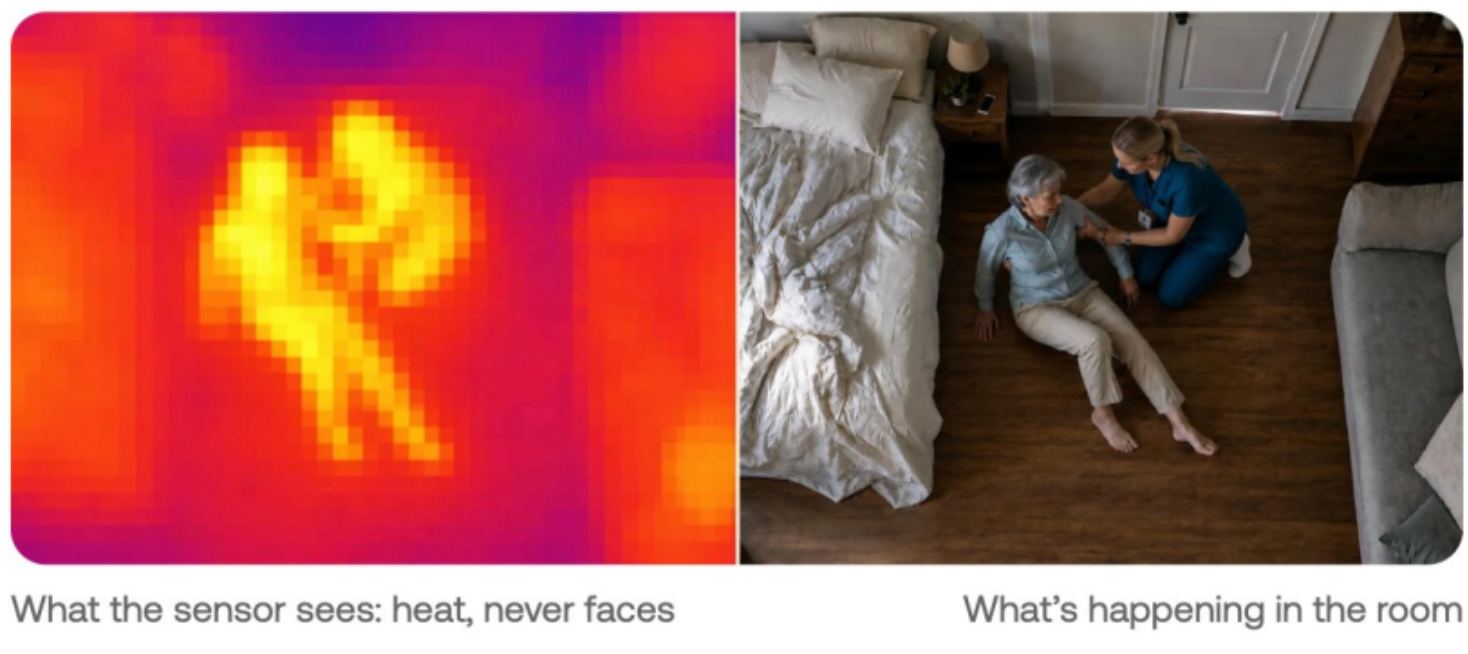
From that data, Butlr Care provides:
- Fall risk indicators: Time in bed and night activity.
- Changes in daily activity patterns: Built from those measures and bathroom visits, then configured together with each community.
- Wandering events: A resident leaving the bed and not returning within a defined overnight window.
- Real-time fall alerting: Flags a possible fall and notifies staff in seconds, for caregiver review.
Every deployment includes a dashboard. SMS, push notifications and webhooks into nurse-call systems are available on request.
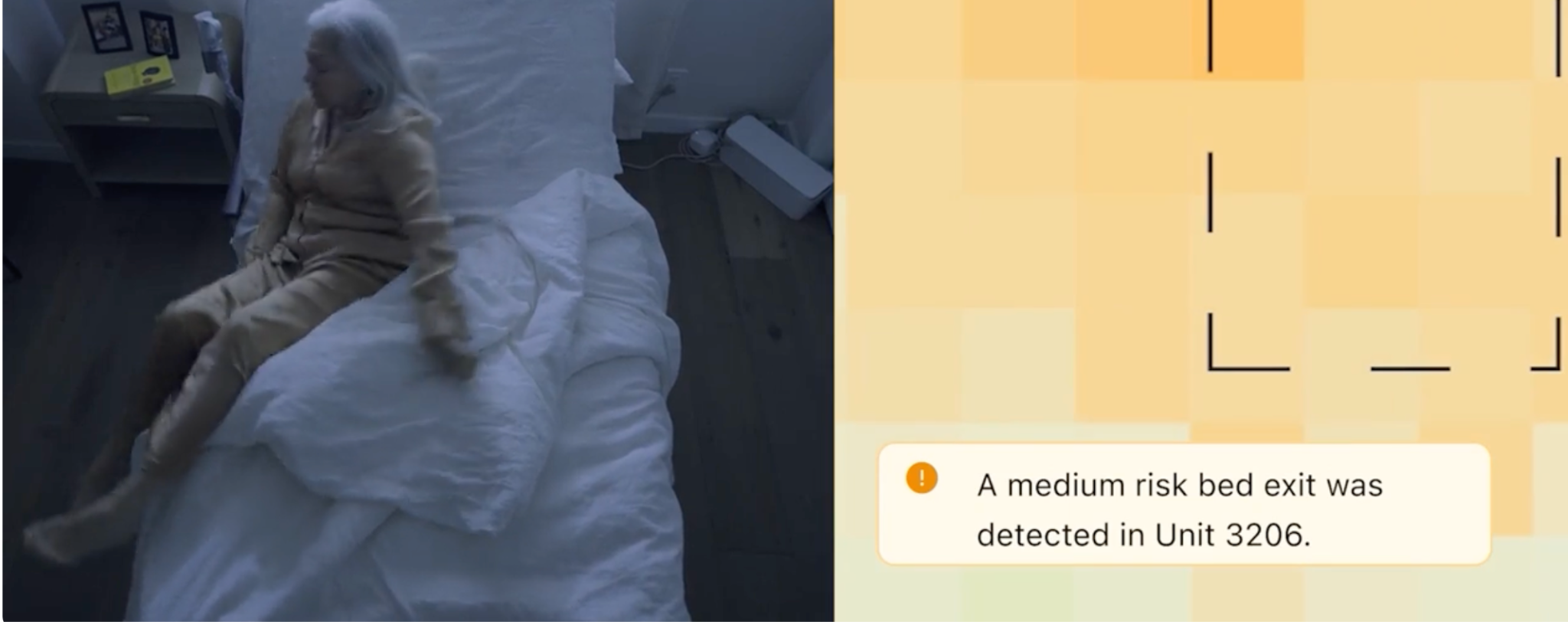
Butlr is also part of ongoing research into earlier frailty detection. It received an a2 Pilot Award through Massachusetts AI and Technology Center for Connected Care in Aging and Alzheimer’s Disease (MassAITC), which is funded by the National Institute on Aging.
The study, conducted at the Senior Health Practice at Beth Israel Deaconess Medical Center, is co-led by Dr. Dae Kim and Amanda Paluch, PhD, of UMass Amherst. It includes 60 older adults across a range of frailty levels, each with ceiling-mounted thermal sensors placed in their home for two to four weeks. The goal is a contactless frailty assessment that asks nothing of the older adult. Read more about the study.
Questions to Ask Before Choosing a Predictive System
We recommend bringing these questions to vendor demos. They focus on whether a system will produce continuous data in your community and whether staff will act on it.
- Which signals does the system measure today? Ask vendors to separate shipped capabilities from roadmap items.
- How is “normal” defined for each resident? Look for per-resident baselines and settings your clinical team can adjust.
- What does it ask of residents? Charging, wearing, consent and cameras all affect whether data is continuous.
- How do trends and alerts reach staff? Check fit with your nurse-call system, dashboards and shift handoffs.
- How does the vendor talk about accuracy? Treat claims like “catches every fall” or “never misses” as a red flag. Ask how alerts are reviewed and cancelled.
- Can you get your data out? API access matters if you want trends in your EHR or analytics tools.
Butlr Care’s fall risk indicators and real-time fall alerting are built to fit into the routines care teams already run. Learn more about Butlr Care and see how it could work in your community.