


.svg)


5 Best Wireless Occupancy Sensors by Use Case for 2026
Most wireless occupancy sensors look similar on a spec sheet. They’re battery-powered, ceiling-mounted, and require no wiring. The capabilities that make a difference, like what the sensor can detect, how the data gets out, and whether it scales across a full portfolio or tops out at a single room, only become clear once you start comparing side by side.
Some occupancy sensors are built for enterprise workplace teams managing hybrid offices across dozens of buildings. Others are designed to toggle lights on and off in a conference room. Both technically count as wireless occupancy sensors. But choosing the wrong-fit category means either overpaying for features you won't use or underinvesting in a system that can't grow with you.
This guide compares five wireless occupancy sensors, each selected as the strongest option in a distinct use case:
- Butlr: Enterprise portfolio intelligence and space utilization
- Disruptive Technologies: Desk-level occupancy monitoring for hot-desking and hybrid work
- TEKTELIC VIVID: IoT and smart building infrastructure, where occupancy is one layer in a broader sensor network
- Leviton Smart Sensors: Lighting automation and energy code compliance
- Acuity Brands nLight: Fixture-integrated controls for spec-driven new construction and major retrofits
We'll break down what each does best and where they have limitations.
Quick Comparison: Wireless Occupancy Sensors at a Glance
Butlr
Best for: Privacy-safe occupancy intelligence across large office buildings, campuses, and multi-building portfolios. Right-sizing space, optimizing operations, and informing lease decisions with accurate utilization data.
Butlr is a privacy-first workplace occupancy intelligence platform for enterprise building portfolios. Our Heatic 2+ sensors use low-resolution thermal signals and AI to understand how people use space.
They analyze presence, headcount, movement patterns, traffic flow, and dwell time, without collecting images or personally identifiable information (PII). With 30,000+ sensors deployed across 100M+ square feet in 22+ countries, Butlr is built for organizations that need accurate, anonymous utilization data at portfolio scale.
Privacy That Enables Full Building Coverage
Most occupancy sensors force a tradeoff between deploying cameras for rich data and using basic motion sensors with limited insight. Butlr takes a different approach. Its thermal-only sensing delivers detailed occupancy intelligence while collecting zero identity data at the hardware level.
Teams can cover restrooms, wellness rooms, healthcare spaces, and other areas where cameras or device tracking would be blocked by legal, IT, or employee relations. In regions with strict data regulations or works council requirements, Butlr passes review because there's no PII to govern. Utilization data reflects the entire building, not just the conference rooms and open floors that were easy to approve.
One Sensor, Two Modes
Heatic 2+ supports two distinct sensing modes, and a single deployment can use both modes across different parts of a building. Presence Mode detects how many people are in a defined area, where they are, and how long they stay, giving teams the data to evaluate room sizing, desk usage, and layout effectiveness.
Traffic Mode counts directional movement at entryways, producing building- or floor-level occupancy counts over time that inform capacity planning, peak demand analysis, and staffing decisions. One sensor type covers both granular space analytics and macro-level traffic patterns, so teams don't need to procure, install, and manage separate hardware as deployments scale.
Data That Feeds Existing Systems
Butlr is built as an infrastructure layer, not a standalone analytics tool. REST APIs and event-driven webhooks push real-time occupancy data into integrated workplace management systems (IWMS), building management systems (BMS), energy platforms, smart cleaning tools, business intelligence (BI) dashboards, and digital twins.
Teams can automate HVAC schedules based on true occupancy rather than fixed timers, trigger cleaning workflows when usage thresholds are met, or combine Butlr data with badge and lease data to build a complete picture for portfolio decisions. Butlr's developer platform also supports custom applications, predictive analytics, and real-time digital twins for organizations that want to build on the data.
Key Wireless Occupancy Sensor Features
- Sensing Technology: Heatic 2+ detects occupancy at 95% accuracy, sampling at three frames per second in Presence Mode and eight frames per second in Traffic Mode.
- Connectivity and Security: Sensors connect via Wi-Fi, Ethernet, or cellular on a 2.4 GHz frequency. TLS 1.2 and AES256 encryption protect the data, and the platform is SOC 2 Type II compliant.
- Deployment: Sensors are battery-powered with multiyear battery life and require no electrician to install. Heatic 2+ is certified for use in the US, Canada, EU, Japan, Singapore, Australia, India, and South Korea.
Shortcomings
- Thermal sensing provides headcount and presence data but doesn't identify individuals. Organizations that need to know who's in a space (for security, access control, or individual tracking) will need a different or complementary system.
- Thermal detection accuracy can be affected by environmental heat sources (direct sunlight, HVAC vents), though Butlr's AI/ML algorithms are designed to compensate for these over time.
What Real Customers Are Saying About Butlr
“I think that Butlr is going to be a critical component because if we make changes to how the labs operate, the first thing we need to do is have a continuity standard—where we use Butlr to identify that there was a problem and then use Butlr to verify whether or not we fixed it. Otherwise, the concept of this being a legitimate experiment goes away if we change the standards from which utilization was measured.”
-Senior Program Manager, @ Global Medical Technology Leader
"Butlr’s thermal approach is more reliable, scalable, and accurate than the other technologies we have seen. The best part: our customers have a seamless experience – we simply pull data and alerts from Butlr’s API and expose it to care staff who are already familiar with our software.”
-Sami Herrala, CTO & Founder @ 9Solutions
Pricing
Custom pricing available upon request.
Optimize square footage and recoup leasing and serviced office costs without sacrificing the employee experience. Get a demo of Butlr to see how occupancy intelligence helps you understand which types of spaces enable employees to do their best work and de-risk portfolio and workspace changes.
Disruptive Technologies
Best for: Understanding desk-level usage patterns in hot-desking or hybrid seating environments without deploying cameras or intrusive under-desk sensors.
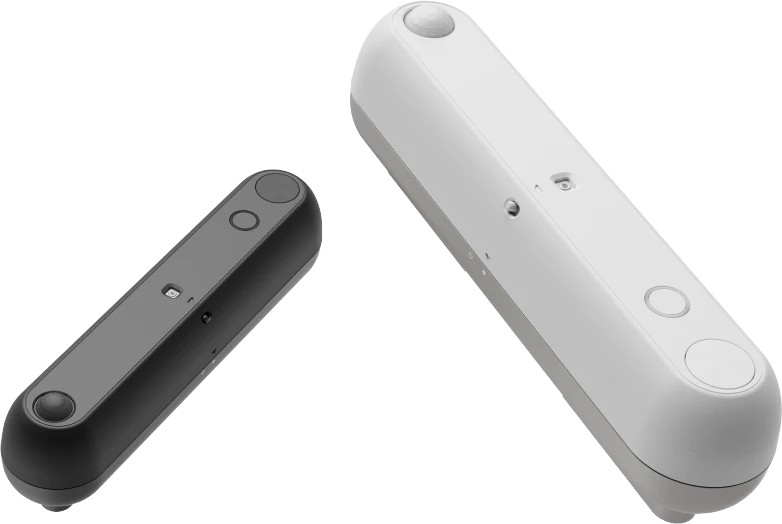
Disruptive Technologies makes small wireless sensors for buildings and assets, collecting data on occupancy, temperature, humidity, CO2, and water detection. Its space occupancy solution pairs a desk sensor with a room-level motion sensor to give workplace teams a clear picture of which desks and meeting rooms are being used and when.
Sensor data flows through a plug-and-play gateway to a cloud-based dashboard where teams can visualize usage patterns, set alerts, and export data. The platform is designed for large-scale deployments where simplicity and long battery life are priorities over data depth.
Key Wireless Occupancy Sensor Features
- Sensing Technology: The desk sensor uses temperature-based machine learning to detect whether a person is present at a workstation. The motion sensor uses passive infrared (PIR) to detect presence in a room. Both provide binary occupied-or-not readings.
- Battery Life and Form Factor: Desk sensors are rated for up to 9 years of battery life, powered by a proprietary semiconductor designed in-house. The form factor is small enough to mount under a desk or on a ceiling without being noticed.
- Connectivity and Infrastructure: Sensors communicate via a proprietary encrypted radio protocol on the 868/915 MHz frequency band. A single gateway supports up to 10,000 sensors and connects to the cloud via cellular (4G/LTE) or Ethernet.
- Integration: REST APIs and webhooks allow teams to forward sensor data into workplace management platforms, BMS, or custom applications. The company's web application also provides dashboards, alerts, and CSV/Excel data export.
Shortcomings
- Disruptive Technologies' sensors don't capture headcount, dwell time, or movement patterns. Teams looking for data beyond the desk or room level will need a different system.
- The proprietary radio protocol means sensors only work with the company's own gateways. Teams can't integrate the hardware into existing Wi-Fi or LoRaWAN infrastructure.
Pricing
Contact Disruptive Technologies for pricing. Sold as hardware with a cloud subscription.
TEKTELIC VIVID

Best for: Adding occupancy as one data layer within an existing (or planned) LoRaWAN IoT infrastructure. It's designed to answer questions around adding presence detection to IoT networks.
TEKTELIC makes end-to-end LoRaWAN IoT solutions, including gateways, sensors, and management software for smart buildings, cities, and industrial environments. VIVID v3 is the company's multi-function room sensor, combining occupancy and motion detection with environmental monitoring in a single device.
The sensor is designed for teams that are already building or operating a LoRaWAN network and want to add presence detection alongside other environmental data. It isn't a standalone occupancy intelligence platform, so occupancy and environmental data feed into whatever systems and applications the team is already running.
Key Wireless Occupancy Sensor Features
- Sensing Technology: VIVID v3 uses a 64-pixel active PIR array to detect presence and motion with fewer false triggers than standard PIR sensors. The sensor also measures ambient temperature, relative humidity, ambient light, and door/window open/close via a magnetic hall effect sensor.
- Mounting Flexibility: The sensor supports wall, ceiling, and desk mounting configurations, each with a different detection range and field of view.
- Battery Life and Installation: The device runs on a single lithium battery with a 60-minute reporting interval. It uses a twist-lock mounting mechanism for fast installation.
- Privacy: The sensor uses PIR detection only. It doesn't capture images, audio, or identity data.
Shortcomings
- VIVID requires a LoRaWAN network to function. Organizations without existing LoRaWAN infrastructure will need to deploy gateways and a network server before they can use VIVID v3, adding cost and complexity that occupancy-focused platforms don't require.
- There are limited native analytics, with only basic dashboards and visualizations available. Extracting meaningful occupancy insights typically requires integration with third-party platforms or custom applications, adding implementation overhead.
Pricing
Contact TEKTELIC for pricing.
Leviton Smart Sensors

Best for: Reliable, low-cost occupancy-based lighting control and energy code compliance (ASHRAE 90.1, IECC, Title 24) without a software platform or data analytics layer.
Leviton makes electrical devices, lighting controls, and building infrastructure products across residential, commercial, and industrial markets. Its smart occupancy sensors are designed to deliver energy savings by turning lights on and off based on whether a room is occupied. They're a code compliance tool for offices, conference rooms, hallways, and restrooms rather than a space analytics platform.
The sensors come in three categories: wallbox sensors for small rooms, ceiling mount sensors for larger spaces, and fixture mount sensors for industrial and outdoor spaces. All can be configured for occupancy mode (auto-on, auto-off) or vacancy mode (manual on, auto-off) and are programmable via a mobile app or pushbutton.
Key Wireless Occupancy Sensor Features
- Sensing Technology: Leviton offers PIR-only and multi-technology (PIR + microphonics) sensor options. PIR detects heat-based motion in a direct line of sight, while multi-technology adds microphonics detection to reduce false-offs in spaces where occupants are stationary or behind obstructions.
- Connectivity and Configuration: Wireless models use Bluetooth for commissioning and configuration via a mobile app. Sensors can also be programmed with pushbutton controls or grouped wirelessly without running new control wiring.
- Power and Voltage: Sensors operate at 120-277VAC. Ceiling mount dimming models support one or two 0-10V dimming zones and one or two daylight harvesting zones.
- Code Compliance: The sensors meet ASHRAE 90.1, IECC, and California Title 24 requirements for automatic lighting shutoff. Configurable time delay settings and occupancy/vacancy modes allow installers to match control behavior to the code, and advanced models also support demand response, plug load and receptacle control, and UL924 emergency lighting integration.
Shortcomings
- Leviton sensors provide binary occupied-or-vacant data and don't capture headcount, dwell time, utilization patterns, or any analytics. The product is designed for lighting control, not space planning.
- PIR-only models can miss stationary occupants in spaces with obstructions. Multi-technology models with microphonics address this but are only available in certain form factors.
Pricing
Contact Leviton for pricing.
Acuity Brands nLight

Best for: Commercial new construction or major LED retrofits where occupancy sensing is specified alongside the lighting package and LEED, ASHRAE 90.1, or Title 24 compliance is a design requirement. This decision happens in architectural plans, not post-occupancy technology evaluations.
Acuity Brands is a large-scale lighting and building technology manufacturer. nLight is the company's networked lighting control platform, and its occupancy sensors are one component within that system. The platform scales from a single room to an entire campus, supporting both wired and wireless devices, with sensors designed to be embedded directly into light fixtures or mounted alongside them.
The platform is spec-driven. Architects and engineers typically select nLight sensors during the design phase of a new building or major retrofit, alongside the lighting fixtures, power packs, and controllers that make up the full system.
Key Wireless Occupancy Sensor Features
- Sensing Technology: nLight sensors use digital PIR detection with multiple lens options for different mounting heights and coverage patterns. Dual-technology models add a second detection method for spaces where occupants are stationary for extended periods, reducing false-offs.
- Connectivity and Architecture: Wireless sensors communicate on a 900 MHz frequency, which penetrates walls and obstructions more reliably than higher-frequency protocols. The system connects to a controller that provides BACnet/IP integration with building management systems, schedule management, and demand response capabilities.
- Scale: A single controller supports up to 750 devices. Additional controllers can connect to scale a system up to 20,000 devices, making nLight viable for large commercial buildings and campus-wide deployments.
- Security: Sensors are configured via a mobile application. The system supports IP-based access, RADIUS authentication, and FIPS 140-2 mode for government and high-security facilities.
Shortcomings
- The system is designed to be incorporated during construction or major retrofits. Deploying it into an existing building without a lighting upgrade involves significant cost and complexity compared to standalone sensor platforms.
- Sensors are fixture-powered, not battery-powered. Wireless wall switches have 10+ year battery ratings, but the core sensing infrastructure requires electrical connections, which means electricians and potentially ceiling work.
Pricing
Contact Acuity Brands for pricing.
FAQs About Wireless Occupancy Sensors
What's the difference between a motion sensor and an occupancy sensor?
A motion sensor detects movement and triggers an action (like turning on a light) but stops detecting once movement stops. An occupancy sensor is designed to determine whether a space is occupied, even when someone is making only minor motions like typing or reading. Some products are sold as vacancy sensors, which work in reverse. Lights must be turned on manually but shut off automatically when the room is empty.
How long do occupancy sensors last?
Battery life varies widely depending on the sensor technology, reporting frequency, and wireless protocol. Some sensors are rated for up to 15 years on a single battery, while others may need replacement every 3-5 years. Hardwired and fixture-powered sensors don't have battery constraints but are tied to the building's electrical infrastructure.
What is a wireless sensor network?
A wireless sensor network is a group of sensors that communicate data to a central system without physical wiring between them. The sensors transmit data over protocols like Wi-Fi, Bluetooth, LoRaWAN, or proprietary radio frequencies to a gateway or cloud platform, where it's analyzed or used to trigger automations. Wireless networks are faster to deploy and easier to reconfigure than wired systems because they don't require additional wiring, which makes them a better fit for retrofits and multi-building rollouts.
Do occupancy sensors have cameras?
Most occupancy sensors don't have cameras. The sensors covered in this guide use PIR, thermal imaging, temperature-based detection, or ultrasonic technology to detect presence without capturing images or video. Thermal sensors like Butlr's Heatic 2+ read low-resolution heat signatures that can't identify individuals, making them deployable in privacy-sensitive spaces where cameras wouldn't be permitted.
.png)

%20(1).png)
.png)
.webp)