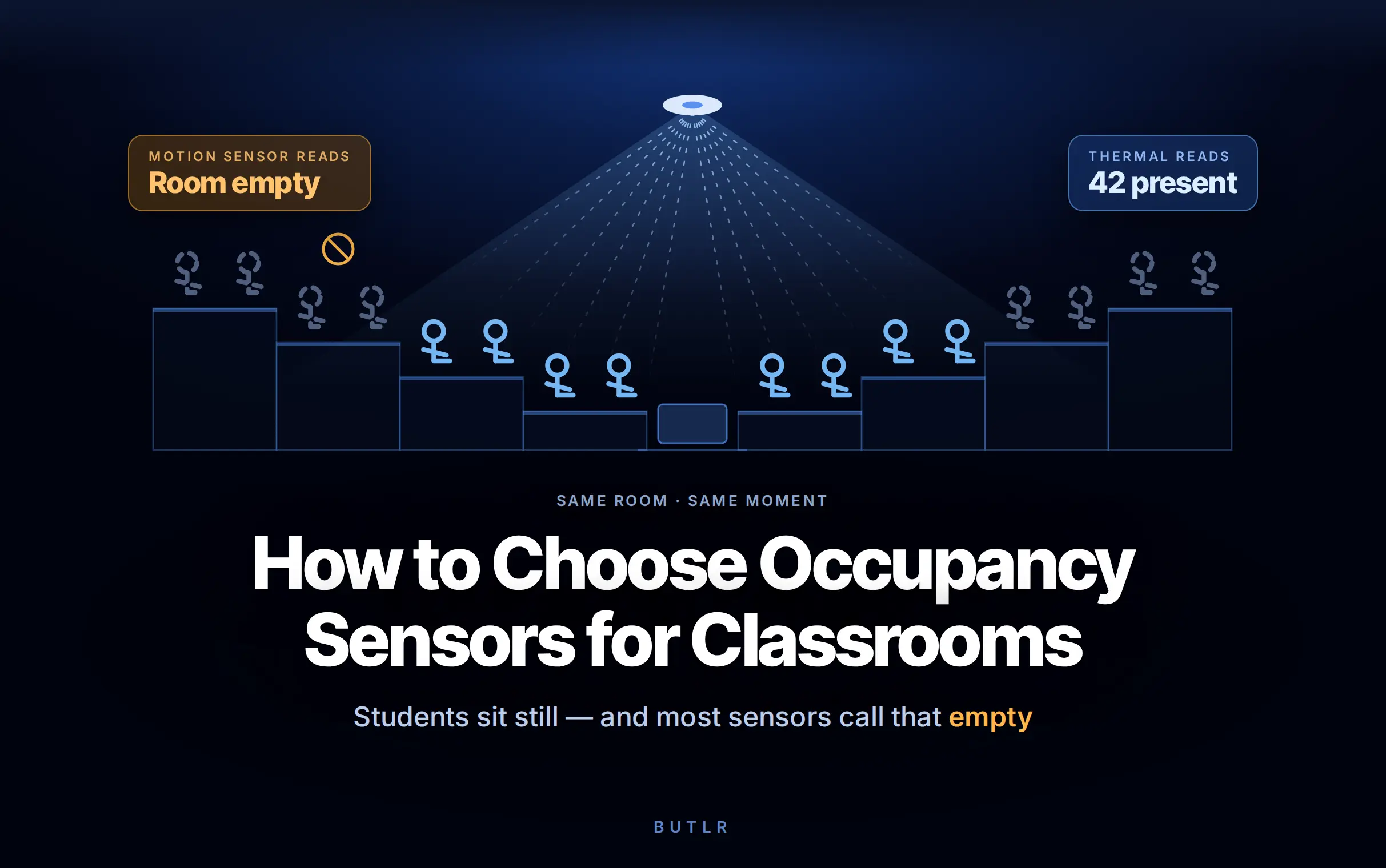

Universities face unique challenges in managing their spaces. From energy efficiency to optimizing collaborative areas, having accurate data about how spaces are used can transform decision-making, reduce costs, and improve campus life.


From anonymous sensing to wireless installations, our sensors are designed to increase time-to-value


Designed with an API-first approach, Butlr can integrate seamlessly with most Building Management System (BMS) applications you are already using, ensuring that real-time occupancy data informs HVAC controls and lighting schedules from day one.
Explore the Butlr API


Occupancy analytics show how many people use each classroom, study space, office, and common area, and when. Facilities, space planning, and sustainability teams use the data to match rooms to class sizes, justify space allocation, and cut energy in spaces that sit empty.
Sensors measure actual attendance in each room throughout the day. Comparing that with room capacity and the class schedule shows which large rooms host small classes and which rooms are overbooked, so schedulers can reassign space with evidence.
No. Butlr sensors read body heat as low-resolution thermal data and cannot capture faces or identities. There are no cameras, badges, or phone tracking, so campus occupancy data is anonymous from the moment it is captured.
Butlr's wireless sensors mount without wiring or drilling and can be installed overnight or over a weekend, so deployments do not need to wait for semester breaks. They suit both historic and modern campus buildings.
Yes. Occupancy data shows which buildings, floors, and rooms are empty, so heating, cooling, and lighting can follow real use. Butlr is API-first and connects to building management systems, so schedules can follow occupancy from day one.