Meet Butlr
Discover what spatial intelligence can do for you.
Thank you! Your submission has been received!
Why camera-free sensing matters
Camera-free sensing uses non-imaging technologies—typically thermal or passive infrared sensors paired with edge AI—to detect presence and movement based on heat or motion, not pictures.
- Privacy-first: no video, no facial recognition, and no personally identifiable imagery are collected. This reduces privacy risk and helps compliance with privacy laws.
- Lower friction for adoption: tenants and visitors are more comfortable with anonymous sensing, especially in restrooms.
- Focused data: systems provide counts, presence, and flow rather than photo archives, producing actionable operational metrics without sensitive data.
Terms to know
- Thermal sensor: detects heat patterns (infrared radiation) to infer presence and occupancy.
- Spatial intelligence: analysis of people movement and patterns inside physical spaces to optimize operations.
- Building Management System (BMS): centralized control platform for HVAC, lighting, and other building systems.
Butlr (https://butlr.com) is one provider of privacy-first, camera-free thermal sensing and spatial intelligence designed for buildings.
Typical use cases in malls and offices
Smart restroom sensing supports multiple operational and customer-experience goals:
- Real-time occupancy monitoring to show restroom availability and reduce perceived wait times.
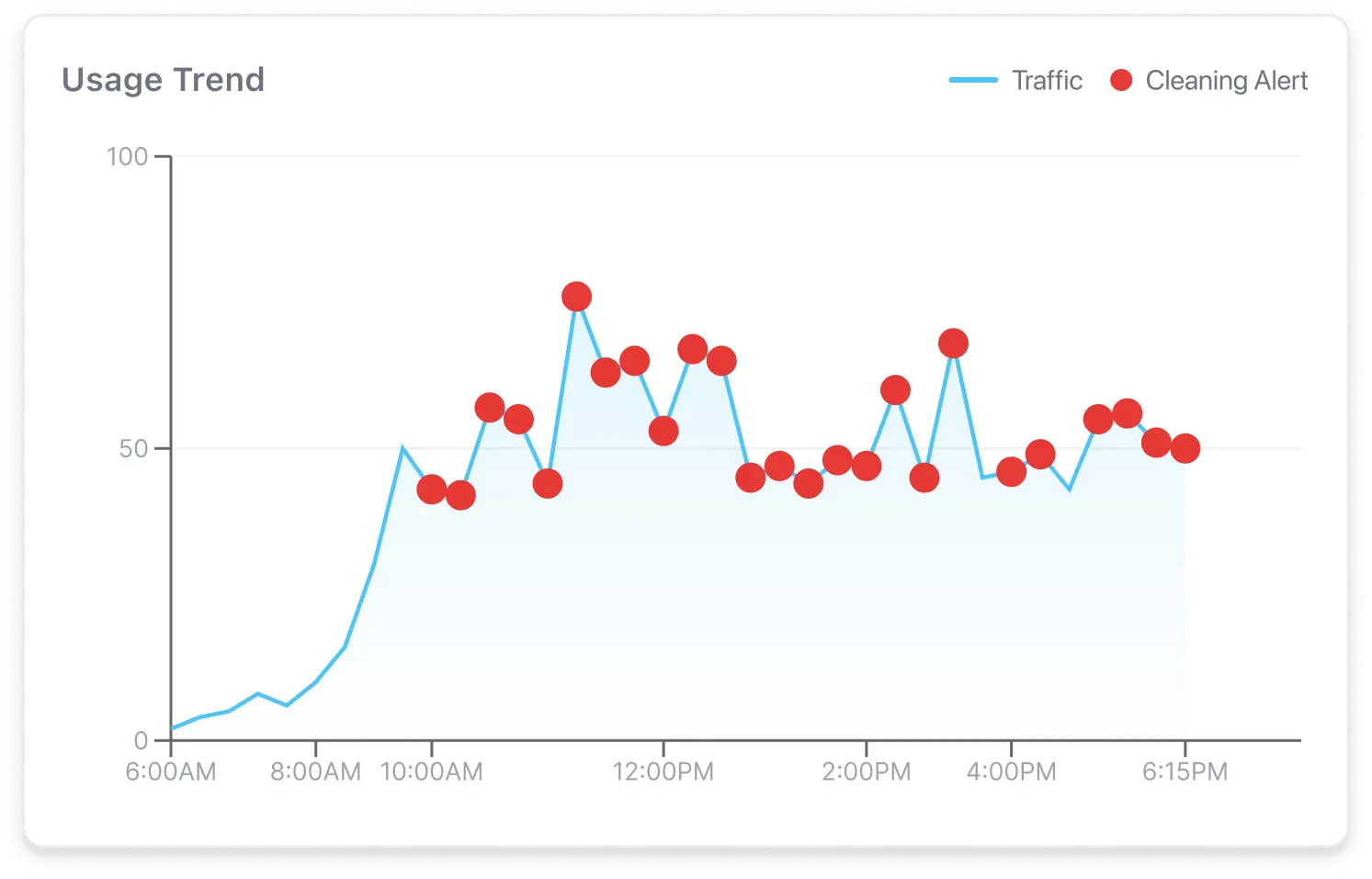
- Dynamic cleaning triggers based on actual usage rather than fixed schedules.
- Queue and peak management for high-traffic zones during events or lunch hours.
- Resource planning (supplies, staff allocation) informed by usage patterns.
- Integration with wayfinding signage and mobile apps to guide visitors to available facilities.
Planning and assessment
Start with a site-specific plan to ensure coverage, accuracy, and minimal disruption.
- Scope the deployment: number of restrooms, stalls, and entry/exit points to monitor.
- Establish objectives: reduce wait times, optimize cleaning routes, improve occupant experience, or measure utilization for redesign.
- Conduct a site survey: note ceiling heights, partitioning, ventilation, blind spots, and power/network availability.
- Determine privacy and compliance requirements: consult legal or privacy teams about retention policies and signage.
A pilot deployment in a subset of restrooms or on one floor helps validate sensor placement, analytics settings, and integration workflows before scaling.