


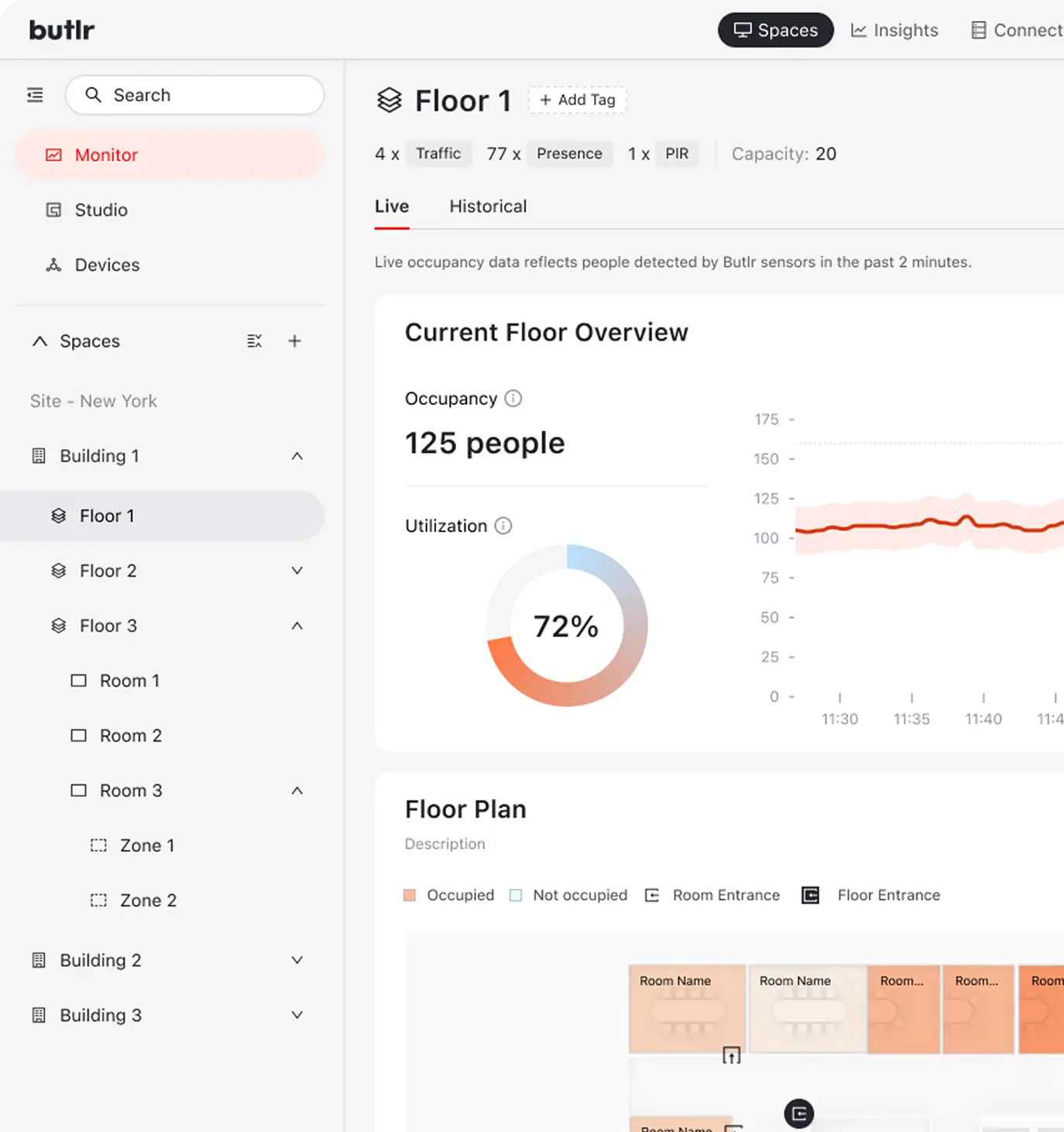
the butlr platform
See how your spaces are really used.
One platform combines body-heat sensing and AI to understand how the world's spaces work. No cameras, no PII, at any scale.
Understand every dimension of your space.
Occupancy is just the beginning. The Butlr Platform analyzes how people move, use, and interact with every environment.
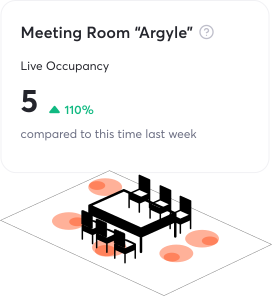
Occupancy & Capacity
Understand how your spaces are actually used. Compare real occupancy with design intent to optimize layouts, capacity, and planning.
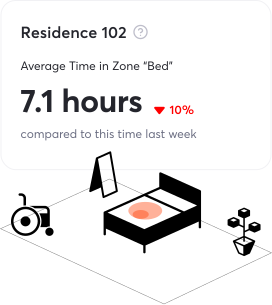
Utilization & Dwell Times
See how people use each space over time. Reveal usage patterns, preferences, and opportunities to improve the experience.
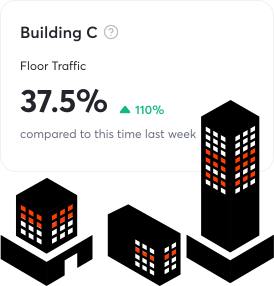
Traffic & Fullness
Go beyond traffic counts to understand real occupancy and distribution. Identify underutilized areas and make smarter space decisions.
How it works
You bring the use case.
We bring everything else.
Install and activate Butlr sensors, organize your spaces, and access occupancy, traffic, and utilization insights directly in the Butlr Platform.

Design
01
Tell us what you need to know. Butlr maps your spaces and designs the deployment: placement, density, wired or wireless, all matched to the use case.
Request A Demo

Sense
02
Heatic sensors read body heat as pixelated thermal data. No cameras, no identities. Wireless installs in minutes with multi-year battery life; wired suits permanent, high-traffic installations. Same sensor family, same platform, switchable without new hardware.
Request A Demo
Scale
03
Start with one floor, grow to a portfolio. Add sensors, reorganize spaces, and connect new buildings without re-platforming.
Request A Demo
Connect the data to your systems.
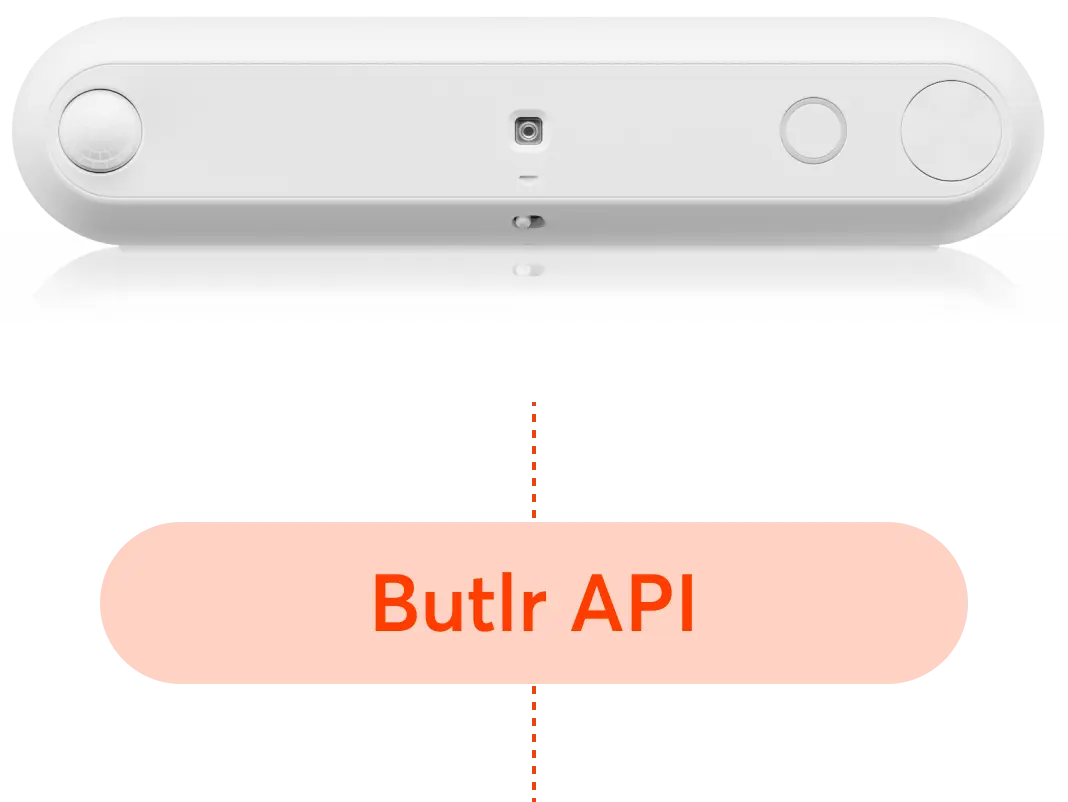
Use Butlr APIs to bring occupancy and spatial intelligence into the tools, workflows, and applications your teams already use.
Space Utilization
Movement Patterns
Traffic Trends & Predictions
Energy Saving Insights
Portfolio Performance
Space Vibrancy
Fall Reduction & Alerting
Predictive Insights
We partner with 30+ software vendors
Butlr offers plug-and-play integrations with 30+ industry-leading software providers. Don’t see your system here? Let’s talk!


“When deployed in combination with our KOLO system, there’s no doubt in my mind that customers will achieve a new level of operational efficiency and hygiene. In tandem, these two technologies have the potential to dramatically and positively impact facility management.”



Privacy & Security
Butlr is designed with privacy at its core. Our people-sensing technology captures presence and occupancy without collecting personally identifiable information. Butlr is also SOC 2 Type II compliant, reinforcing our commitment to protecting customer data and maintaining strong security practices.
Request our SOC2 Type II Certificate

No. Every Heatic sensor, wired or wireless, runs the same platform. Butlr designs the deployment around your use case, and you can switch modes without buying new hardware. Our sensors can also connect via cellular network if needed.
Is any personal data collected?
No. Heatic sensors capture pixels of temperature data, so identifiable information is never collected. It's how our hardware is designed.
Does Butlr work with my existing systems?
Yes. Plug-and-play integrations with leading workplace and building platforms, plus APIs and webhooks are available as part of the Butlr Platform.
How fast can we deploy?
Heactic wireless sensors mount magnetically with no wiring and easily swappable batteries. Regardless of installation method, our sensors start delivering insights as soon as they are online.